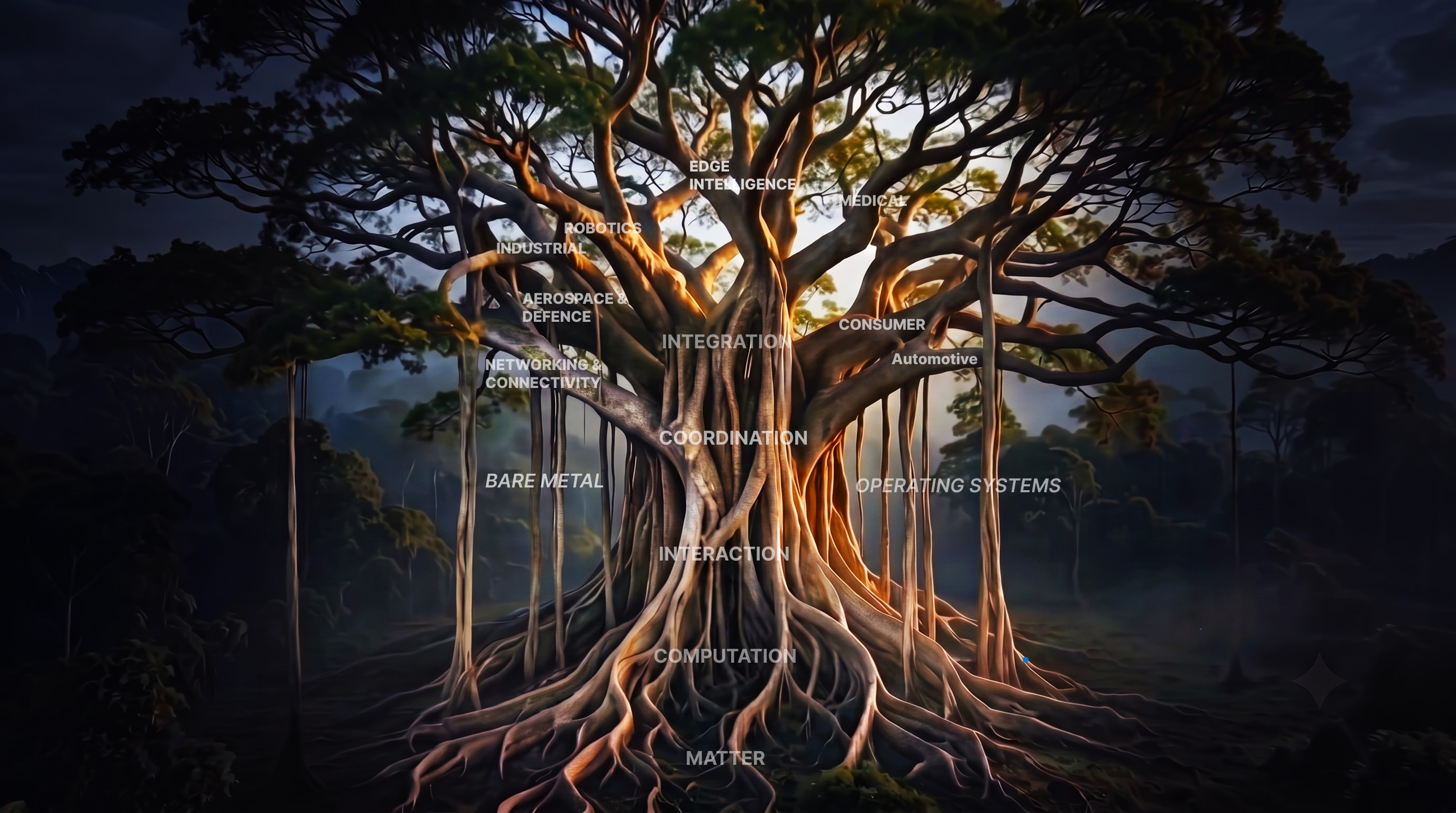
Explore the ideas, systems and connections that shape technology — choose any node to begin your journey.
Embedded Systems Tree
Sort by:
Edge AI Demonstrations
Deploying neural networks and intelligent decision loops on raw silicon targets.
Sort:
Operating Systems
The Rules of Fairness
How the Kernel turns difficult choices into predictable decisions.
KernelSchedulingPoliciesArchitecture
Policies vs. Mechanisms
To understand how a scheduler works, we must distinguish between two related concepts:
* The Mechanism (The Scheduler): This is the code that performs the transition from one Process to another. The technical details of this transition, known as a Context Switch, will be explored later in our Operating Systems journey.
* The Policy (The Ruleset): This is the algorithm or set of rules that determines which process from the Ready Queue should be selected next.
The mechanism is universal—it remains the same regardless of what programs you are running. The policy is configurable—it changes depending on what goals the system is trying to optimize.
Why Multiple Policies Exist
There is no single "correct" policy because there is no single engineering goal. Different computer systems prioritize different objectives:
* Fairness: Ensuring that every active process eventually gets a turn on the processor. No process should starve in memory indefinitely.
* Responsiveness: Prioritizing user interaction. A text editor or cursor should respond within milliseconds, even if heavy background calculations are running.
* Throughput: Maximizing the total number of processes completed per hour. This is vital for servers running background data-processing batches.
* Real-Time Behaviour: Guaranteeing that critical tasks execute within strict deadlines. An engine controller sensor loop must run on time, no matter what.
A scheduling policy is an expression of what a system values most.
Four Classic Scheduling Policies
Modern operating systems like Linux, Windows, or macOS use highly sophisticated scheduling architectures. However, these complex production schedulers are built upon a small set of classic, foundational concepts.
Before we can understand how modern schedulers combine these ideas, we must first understand the four classic policies that represent the historical foundations of scheduling:
1. First-Come, First-Served (FCFS)
* The Idea: "Respect arrival."
* The scheduler selects whichever process arrived first in the Ready Queue. It runs until it yields or terminates.
2. Shortest Job First (SJF)
* The Idea: "Finish quickly."
* The scheduler examines all ready processes and runs the one with the shortest estimated execution duration first.
3. Priority Scheduling
* The Idea: "Protect what matters most."
* Each process is assigned a priority value. The scheduler always executes the process with the highest priority first.
4. Round Robin (RR)
* The Idea: "Everyone deserves a turn."
* The scheduler gives each process a tiny, fixed slice of execution time (a quantum). When time runs out, the process is preempted and sent to the back of the queue.
These classic policies introduced different ways of thinking about fairness. Each solved a particular engineering problem, but each also revealed new, unforeseen limitations.
Before we understand how modern operating systems schedule processes, we must first understand these foundations.
Engineering concepts you don't just read — you experience.
Founded in 2026.
PrajnaEdge is a technology company exploring the space between understanding technology, experimenting with ideas, and turning them into things that can be experienced.
Our Mission
To make technology easier to explore, deeper to understand, and more exciting to experience.
Our Vision
To build a technology ecosystem where curiosity, experimentation and creation continuously lead to one another.
Where it began
Embedded Systems
PrajnaEdge began with Embedded Systems — exploring the foundations that connect hardware, software and intelligent computation.
The first technology universe is built around that foundation. The journey will expand as new ideas, experiments and products emerge.
I am the engineer behind the design, development, and content of PrajnaEdge. I build low-level systems where code directly controls hardware, bridging the gap between register-level silicon behavior and intelligent edge decision loops.
I am an Embedded Firmware Engineer focused on developing software for resource-constrained systems. My experience spans bare-metal firmware, device drivers, microcontroller peripherals, and communication protocols, working across the boundary between hardware and software.
My work has involved microcontroller-based systems, real-time behaviour, hardware interfaces, and communication technologies such as CAN, CAN FD, UART, SPI, and I²C. I am particularly interested in understanding systems from the lowest level upward—from registers and peripherals to intelligent edge systems.
ENGINEERING PHILOSOPHY
Engineering is not just about writing code; it is about managing constraints, timings, and physical hardware characteristics. True mastery of complex systems comes from understanding the interactions across different layers of the stack.
This conviction is why I built PrajnaEdge—to bridge the gap between conceptual theory and direct, register-level physical reality.
Open to collaborations, research, and interesting engineering conversations.
Help Improve PrajnaEdge
Found something to improve? I'd love to hear your thoughts.
Bare Metal
Software that runs directly on hardware without an operating system.
Applications
↑
Operating Systems
YOU ARE HERE
Bare Metal
Processor
↑
Hardware
"Every embedded application begins long before main()."
Operating Systems
An Operating System manages hardware and software resources so complex applications can work efficiently.
Applications
↑
YOU ARE HERE
Operating Systems
Bare Metal
↑
Processor
↑
Hardware
"When one loop is no longer enough to carry the burden."
Support PrajnaEdge
PrajnaEdge is an independent education platform built to make knowledge freely accessible.
If you find PrajnaEdge useful, you can support its continued development.
Your support helps fund the time, tools, infrastructure, and experimentation that go into building and maintaining PrajnaEdge.
Select Region
Select Amount
₹
Select an amount to support PrajnaEdge.
Legal Information
Product Terms & Licensing
1. Terms of Use
PrajnaEdge is an interactive learning platform designed for systems engineers, developers, and technology enthusiasts. The educational materials, simulation blocks, and visual code tracers are provided for instruction and concept validation. We make no warranty regarding their completeness or applicability to real-world industrial systems.
PrajnaEdge is committed to learning privacy. We do not sell user data. Analytical event tracking is used solely to study click telemetry and help improve visual guides.