Explore AI that moves inference closer to the data — from the edge to the device itself.
Can this image classifier maintain its intelligence while becoming small enough for the edge?
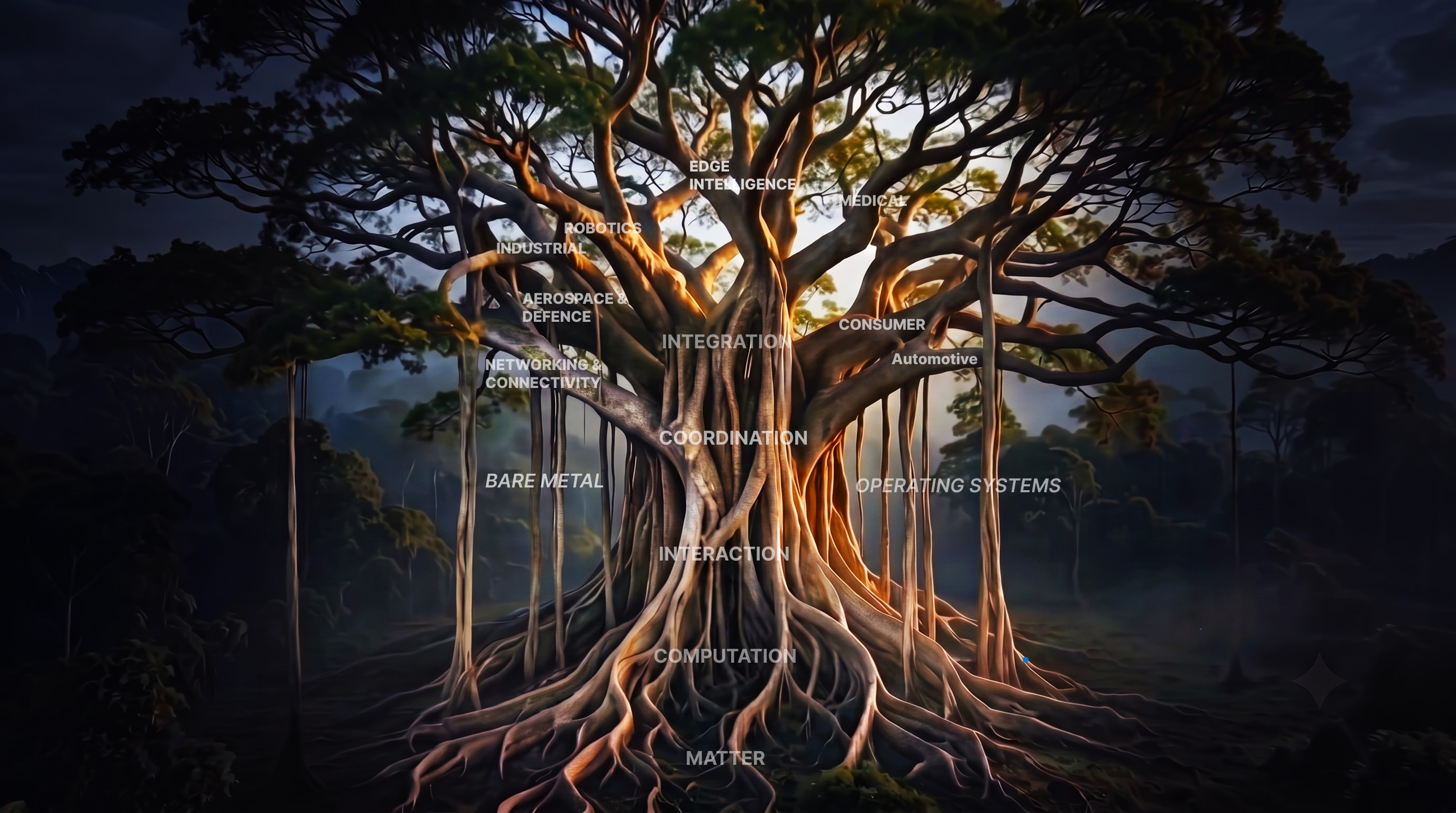
Explore the ideas, systems and connections that shape technology — choose any node to begin your journey.
Deploying neural networks and intelligent decision loops on raw silicon targets.
Understanding who decides which Process gets the processor.
To coordinate this competition, the operating system kernel relies on a core component: the Scheduler.
The Scheduler is the gatekeeper of execution. Its role is simple to state, yet highly complex to engineer: it decides which process in the Ready queue receives CPU time, and when. At this stage, we do not care how it makes this decision (which algorithm it uses). We only care about its role as the manager of execution.
Operating systems divide this task into three distinct types of schedulers, each operating on a different timescale and handling a different state of the process lifecycle.
* The Question: Which programs on disk should become active processes in memory? * The Purpose: When you start a program, it doesn't instantly run on the CPU. The Long-Term Scheduler determines if the system has enough RAM and resources to allocate a new process. It controls the degree of multiprogramming—the total number of active processes residing in memory. It runs slowly, only when new tasks are created.
* The Question: Which processes should temporarily leave memory to free up RAM? * The Purpose: If too many processes are running, the system runs out of physical memory, leading to thrashing. The Medium-Term Scheduler temporarily removes inactive or blocked processes from RAM and writes their state to a swap space on disk. This is called Swapping. When memory pressure drops, it swaps them back into RAM.
* The Question: Among the ready processes in RAM, who gets the CPU next? * The Purpose: This is the primary scheduler. It operates at microsecond speeds. Whenever a running process yields, finishes, or gets interrupted, the Short-Term Scheduler instantly selects the next process from the Ready Queue and dispatches it onto the CPU.
The diagram below visualizes exactly where these three schedulers sit and operate across the process lifecycle states:
PrajnaEdge is a technology company exploring the space between understanding technology, experimenting with ideas, and turning them into things that can be experienced.
PrajnaEdge began with Embedded Systems — exploring the foundations that connect hardware, software and intelligent computation.
The first technology universe is built around that foundation. The journey will expand as new ideas, experiments and products emerge.
PrajnaEdge is a technology company created by Devaharsha Meesarapu.
I am the engineer behind the design, development, and content of PrajnaEdge. I build low-level systems where code directly controls hardware, bridging the gap between register-level silicon behavior and intelligent edge decision loops.
I am an Embedded Firmware Engineer focused on developing software for resource-constrained systems. My experience spans bare-metal firmware, device drivers, microcontroller peripherals, and communication protocols, working across the boundary between hardware and software.
My work has involved microcontroller-based systems, real-time behaviour, hardware interfaces, and communication technologies such as CAN, CAN FD, UART, SPI, and I²C. I am particularly interested in understanding systems from the lowest level upward—from registers and peripherals to intelligent edge systems.
Engineering is not just about writing code; it is about managing constraints, timings, and physical hardware characteristics. True mastery of complex systems comes from understanding the interactions across different layers of the stack.
This conviction is why I built PrajnaEdge—to bridge the gap between conceptual theory and direct, register-level physical reality.
Software that runs directly on hardware without an operating system.
"Every embedded application begins long before main()."
An Operating System manages hardware and software resources so complex applications can work efficiently.
"When one loop is no longer enough to carry the burden."
PrajnaEdge is an independent education platform built to make knowledge freely accessible.
If you find PrajnaEdge useful, you can support its continued development.
Your support helps fund the time, tools, infrastructure, and experimentation that go into building and maintaining PrajnaEdge.
Product Terms & Licensing
PrajnaEdge is an interactive learning platform designed for systems engineers, developers, and technology enthusiasts. The educational materials, simulation blocks, and visual code tracers are provided for instruction and concept validation. We make no warranty regarding their completeness or applicability to real-world industrial systems.
The software, interactive widgets, diagrams, illustrations, custom SVG architectures, and textual documentation on this site are copyright © 2026 PrajnaEdge. All rights reserved. Reproduction, modifications, or scraping of this content without prior written permission is strictly prohibited.
PrajnaEdge is committed to learning privacy. We do not sell user data. Analytical event tracking is used solely to study click telemetry and help improve visual guides.