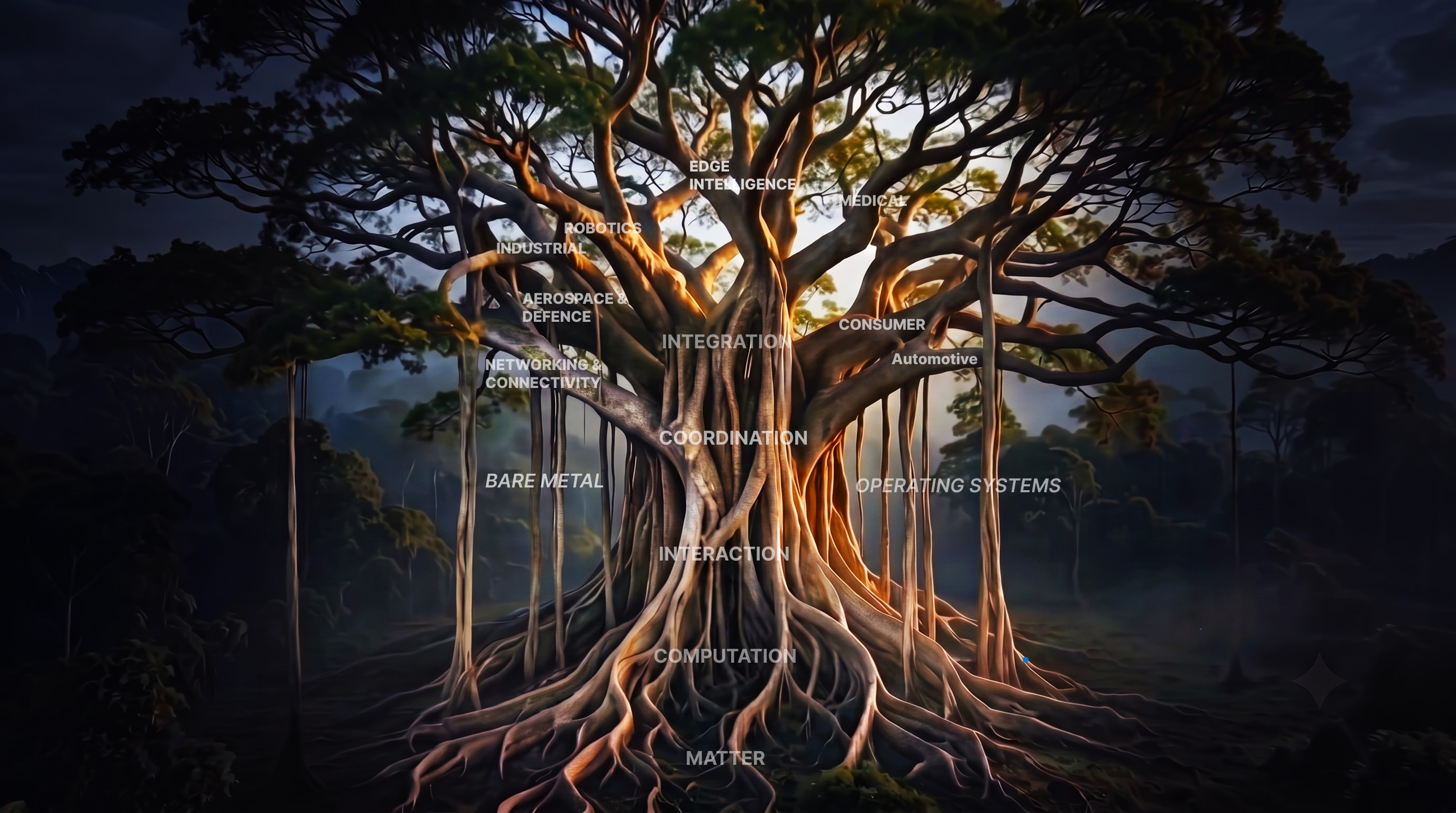
Explore the ideas, systems and connections that shape technology — choose any node to begin your journey.
Embedded Systems Tree
Sort by:
Edge AI Demonstrations
Deploying neural networks and intelligent decision loops on raw silicon targets.
Sort:
Operating Systems
When One Rule Was Enough
Understanding Non-Preemptive Scheduling
KernelSchedulingNon-PreemptiveFCFSSJFPriority
The Non-Preemptive Execution Flow
To visualize this philosophy, consider the lifecycle of execution. Once a process is selected from the Ready Queue, it enters the running state and remains there. The CPU cannot swap it out mid-way.
Three Classic Non-Preemptive Policies
When the kernel does not interrupt, the only choice it makes is who starts next. This choice is guided by one of three classic rules:
* First-Come, First-Served (FCFS): The simplest possible rule. Whichever process enters the Ready Queue first is run first, regardless of how long it takes or its importance.
* Shortest Job First (SJF): The scheduler searches the Ready Queue and executes the process with the shortest estimated burst time first.
* Priority Scheduling: Each process is tagged with an integer representing its priority. The scheduler always starts the process with the highest priority next.
Investigating Scheduling Behavior
To see how these rules change the behavior of a system, let's trace them using a single, identical set of processes.
The Key Metrics: Turnaround vs. Waiting
When evaluating these schedulers, engineers look at two primary performance metrics:
* Turnaround Time ($TAT$): The total elapsed time from when a process first arrives in the queue to when it completely finishes execution ($TAT = \text{Completion Time} - \text{Arrival Time}$).
* Waiting Time ($WT$): The total time a process spends sitting in the Ready Queue waiting to execute ($WT = \text{Turnaround Time} - \text{Burst Time}$).
As you simulated above:
* FCFS scheduled processes exactly in arrival sequence, resulting in an average waiting time of 4.67 units.
* SJF reduced average waiting time to 3.67 units by running the shorter $P_3$ before $P_2$.
* Priority prioritized the urgent $P_2$ over $P_3$, resulting in an average waiting time of 4.67 units.
The EdgeCase: Emergency Arrival
These non-preemptive rules worked well for early batch-processing computers. But what happens in a real-time system when an critical task suddenly wakes up?
Select the EdgeCase simulation tab above. In this scenario, we use the exact same process table, but we introduce one addition: at Time = 1, an emergency process ($P_{EM}$) with priority 0 (highest) arrives.
Observe the timeline:
* At Time = 0, $P_1$ begins running.
* At Time = 1, $P_{EM}$ arrives. It is the most critical process in the system.
* But because the scheduler is non-preemptive, $P_1$ cannot be interrupted. $P_{EM}$ is forced to wait in the Ready Queue for 5 full time units until $P_1$ finishes at Time = 6.
This is the fundamental limitation of non-preemptive scheduling: long-running tasks block critical work, and the kernel is powerless to stop them.
The early policies were simple and predictable. But when a system must react to user inputs or critical hardware interrupts, waiting is no longer an option.
Should the CPU continue executing a long task, or should it force it to yield?
Let's find out how the kernel breaks the rule of non-preemption.
Engineering concepts you don't just read — you experience.
Founded in 2026.
PrajnaEdge is a technology company exploring the space between understanding technology, experimenting with ideas, and turning them into things that can be experienced.
Our Mission
To make technology easier to explore, deeper to understand, and more exciting to experience.
Our Vision
To build a technology ecosystem where curiosity, experimentation and creation continuously lead to one another.
Where it began
Embedded Systems
PrajnaEdge began with Embedded Systems — exploring the foundations that connect hardware, software and intelligent computation.
The first technology universe is built around that foundation. The journey will expand as new ideas, experiments and products emerge.
I am the engineer behind the design, development, and content of PrajnaEdge. I build low-level systems where code directly controls hardware, bridging the gap between register-level silicon behavior and intelligent edge decision loops.
I am an Embedded Firmware Engineer focused on developing software for resource-constrained systems. My experience spans bare-metal firmware, device drivers, microcontroller peripherals, and communication protocols, working across the boundary between hardware and software.
My work has involved microcontroller-based systems, real-time behaviour, hardware interfaces, and communication technologies such as CAN, CAN FD, UART, SPI, and I²C. I am particularly interested in understanding systems from the lowest level upward—from registers and peripherals to intelligent edge systems.
ENGINEERING PHILOSOPHY
Engineering is not just about writing code; it is about managing constraints, timings, and physical hardware characteristics. True mastery of complex systems comes from understanding the interactions across different layers of the stack.
This conviction is why I built PrajnaEdge—to bridge the gap between conceptual theory and direct, register-level physical reality.
Open to collaborations, research, and interesting engineering conversations.
Help Improve PrajnaEdge
Found something to improve? I'd love to hear your thoughts.
Bare Metal
Software that runs directly on hardware without an operating system.
Applications
↑
Operating Systems
YOU ARE HERE
Bare Metal
Processor
↑
Hardware
"Every embedded application begins long before main()."
Operating Systems
An Operating System manages hardware and software resources so complex applications can work efficiently.
Applications
↑
YOU ARE HERE
Operating Systems
Bare Metal
↑
Processor
↑
Hardware
"When one loop is no longer enough to carry the burden."
Support PrajnaEdge
PrajnaEdge is an independent education platform built to make knowledge freely accessible.
If you find PrajnaEdge useful, you can support its continued development.
Your support helps fund the time, tools, infrastructure, and experimentation that go into building and maintaining PrajnaEdge.
Select Region
Select Amount
₹
Select an amount to support PrajnaEdge.
Legal Information
Product Terms & Licensing
1. Terms of Use
PrajnaEdge is an interactive learning platform designed for systems engineers, developers, and technology enthusiasts. The educational materials, simulation blocks, and visual code tracers are provided for instruction and concept validation. We make no warranty regarding their completeness or applicability to real-world industrial systems.
PrajnaEdge is committed to learning privacy. We do not sell user data. Analytical event tracking is used solely to study click telemetry and help improve visual guides.