PrajnaEdge is not navigated like a conventional website. Knowledge is represented through paths, structures, and transitions.
Matter
NodeClick a node name to enter that concept and continue along the awakened path.
ExplorationsStep-by-step learning experiences containing theory, architecture, and interactive elements.
SetuA Setu connects related concepts that can be explored independently from the main sequence.
VortexA Vortex opens a path toward another knowledge area, foundation, or future domain.
BlackholeA deeper exploration space opened through the Vortex, where you select the depth of investigation.
AntarguhaA concealed exploration existing outside the regular path, waiting to be discovered within the system.
For the best experience, open PrajnaEdge on a desktop or laptop screen.
PrajnaEdge
A curiosphere for curious minds who want to understand, experiment with, and experience technology.
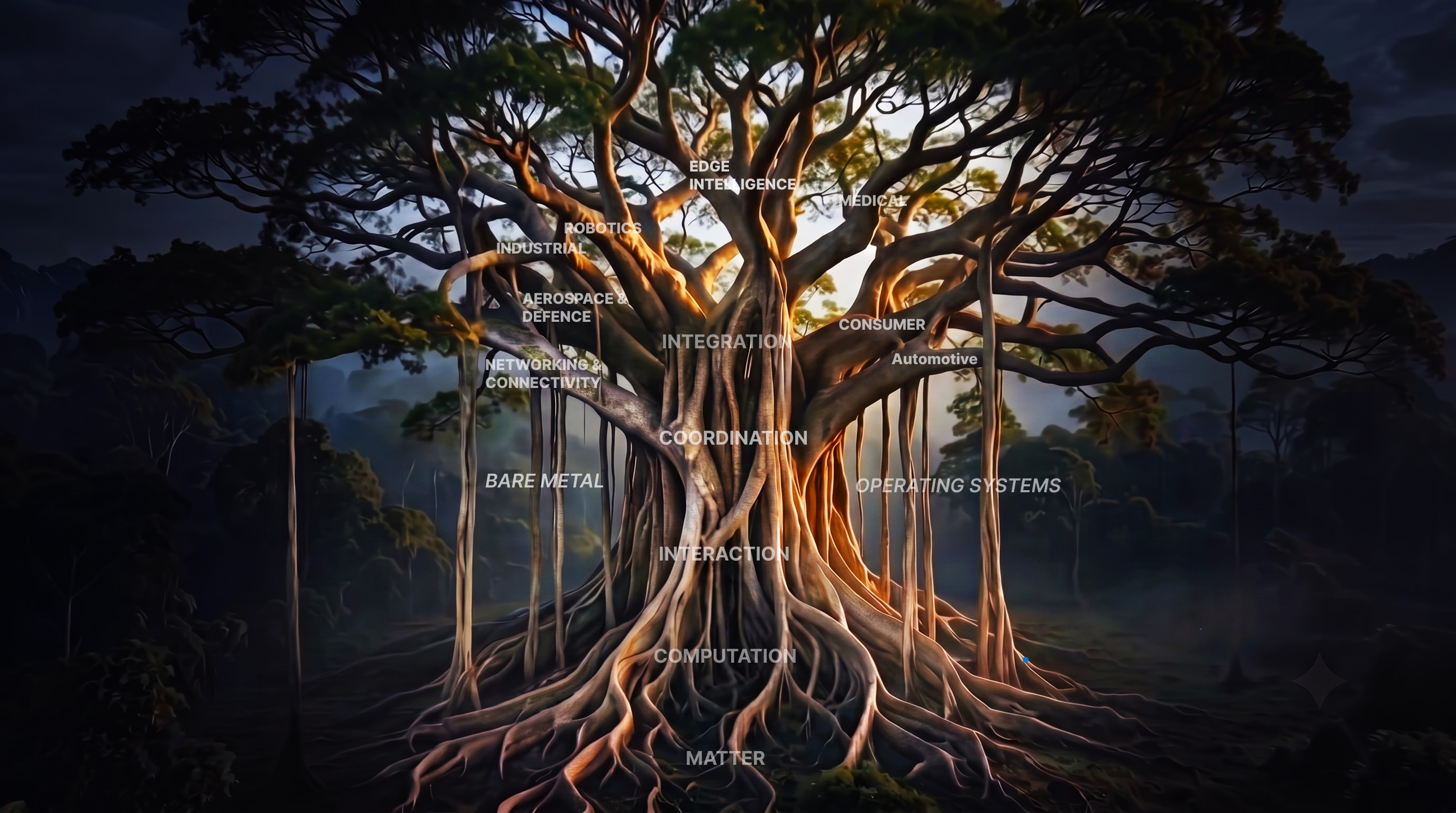
Technology is a system of connections.
Modern technology is built from layers that continuously interact with one another. At the physical level, electronic devices transform electrical signals into digital information. Digital logic turns that information into computation, while processors, memory and communication interfaces provide the machinery needed to execute instructions and move data. As these components become part of embedded systems, they begin to interact with the physical world through sensors, controllers, actuators and real-time software.
But computation does not exist in isolation. Operating systems coordinate hardware and software, firmware gives specialized machines their behaviour, and communication protocols allow independent systems to exchange information. At the same time, machine learning is moving beyond the cloud into edge and on-device systems, where models must operate within real constraints such as memory, processing power, latency and energy consumption.
PrajnaEdge explores these connections as one continuous technology landscape — and takes them beyond explanation. From computing foundations and embedded systems to intelligent machines and edge AI, ideas can be understood, experimented with, and eventually turned into technology that can be experienced in the real world.
PrajnaEdge products and technology experiences are currently in development.
In Development
Playground
Experiment with intelligence beyond the cloud.
AI inference performed closer to where data is generated — optimizing model representation to reduce latency, memory footprint, and bandwidth requirements.
Run an optimized, trained model directly on physical embedded silicon.
Cloud AIComing Soon
Model Training & Representation
Explore how neural networks learn representations from data before compression and deployment. Future experiments will allow adjusting learning parameters—such as learning rate, epoch counts, and batch sizes—to observe loss trajectories and decision boundaries.
Edge AIComputer Vision
Image Classification
Can this image classifier maintain its intelligence while becoming small enough for the edge?
On-device AIAI-Thinker ESP32-CAM
On-device Image Classification
Run a fully quantized INT8 image-classification model directly on embedded hardware.
On-device AIComing Soon
On-Device Model Adaptation
Can a constrained edge device adapt or fine-tune model parameters directly using local data? Exploring on-device transfer learning and few-shot adaptation under strict compute, memory, and thermal limits.
Edge AI Playground
Image Classification
Can this image classifier maintain its intelligence while becoming small enough for the edge?
Choose an image
Upload an image
Supports JPG, JPEG, PNG
This classifier recognizes only Apple, Banana, and Orange. Other objects may be incorrectly classified as one of these classes.
Run a fully quantized INT8 image-classification model directly on embedded hardware.
This experiment investigates preparing a compact INT8 TensorFlow Lite model for direct inference on resource-constrained embedded hardware. The model uses the same CNN architecture as the Edge AI exploration, converted to a full INT8 representation to classify three classes: Apple, Banana, and Orange.
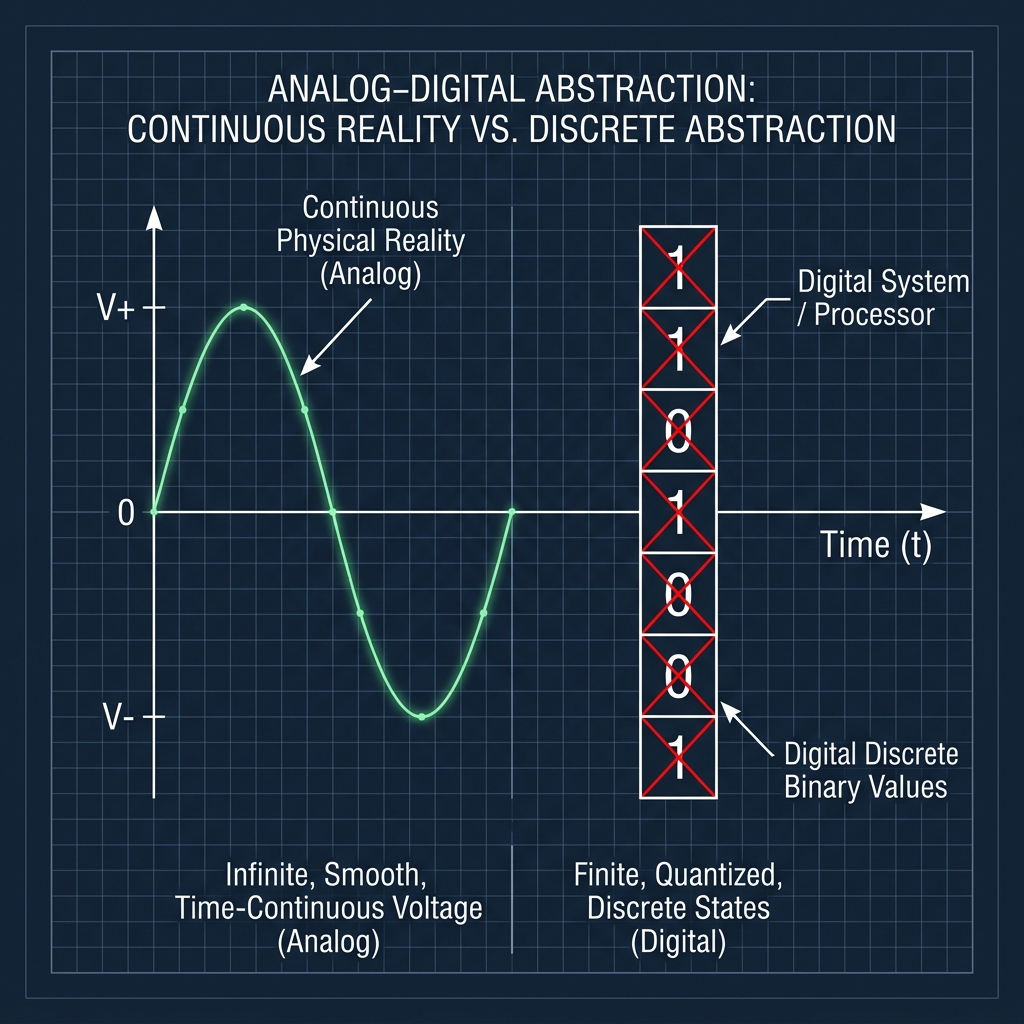
The physical world is fluid, continuous, and unbroken. If you measure the temperature of a room, it does not jump instantly from 22°C to 23°C; it transitions through an infinite number of intermediate states. The pressure of sound waves hitting a microphone, the changing angle of a steering wheel potentiometer, the terminal voltage of a discharging lithium-ion battery, and the intensity of morning light are all continuous. They exist as physical quantities that can take any value within a range, changing smoothly across time.
Continuous physical waveforms vs discrete computer states
2. Why Computers Cannot Directly Understand Analog Signals
A digital processor, by contrast, is a machine of absolute division. Inside its silicon core, electricity is gated into binary states: a transistor is either fully conducting or cut off, representing a logical 1 or 0. A processor cannot store 'a slightly warm voltage' or 'a loud sound wave' in its registers. It understands only precise digital numbers. To bridge this gap between continuous physical reality and discrete computation, the system needs an interface that translates raw, infinitely variable analog signals into finite, structured digital words. This interface is the Analog-to-Digital Converter (ADC).
3. Sampling: Freezing Time
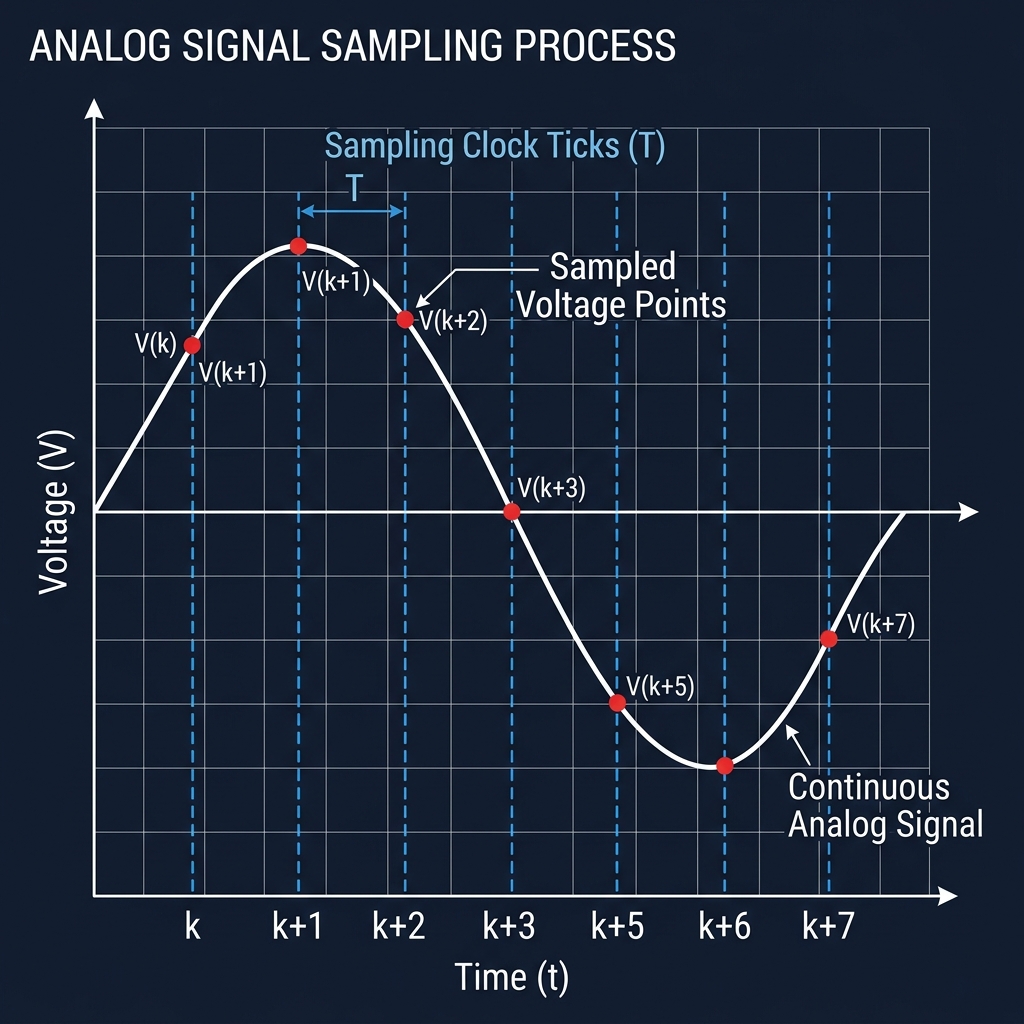
The first step of this translation is Sampling. Since a computer cannot observe the world constantly, it must observe it at discrete moments. Sampling is the process of reading the analog voltage of a signal at precise, regular intervals.
This is where we connect back to the Hardware Timer. A timer serves as the clock heartbeat of the system, asserting trigger events to dictate exactly when the ADC should observe. By sampling at a fast enough rate, the machine captures enough snapshots of the signal to represent its behavior across time.
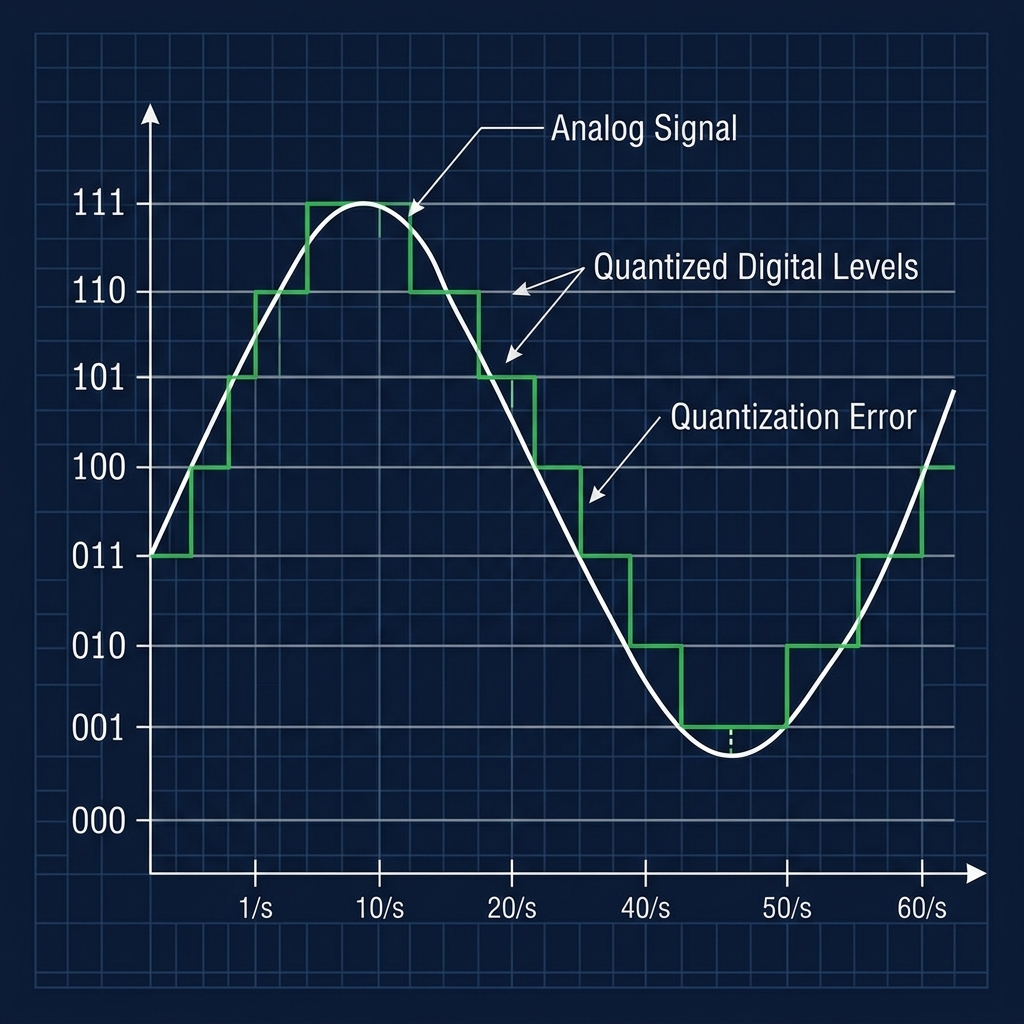
Freezing time via sampling is only half the battle. At each sampling moment, the voltage level is still a continuous value with infinite decimal possibilities. A computer has a finite number of bits to represent this value, so it must map this infinite voltage to the nearest level on a pre-defined digital staircase. This mapping process is called Quantization.
Quantization discards the infinite sub-millivolt details, rounding the physical voltage to the closest discrete step. The tiny difference between the true analog voltage and the rounded digital level is called Quantization Error.
Continuous signal mapped onto discrete binary quantization levels
5. Resolution: The Fineness of the Mesh
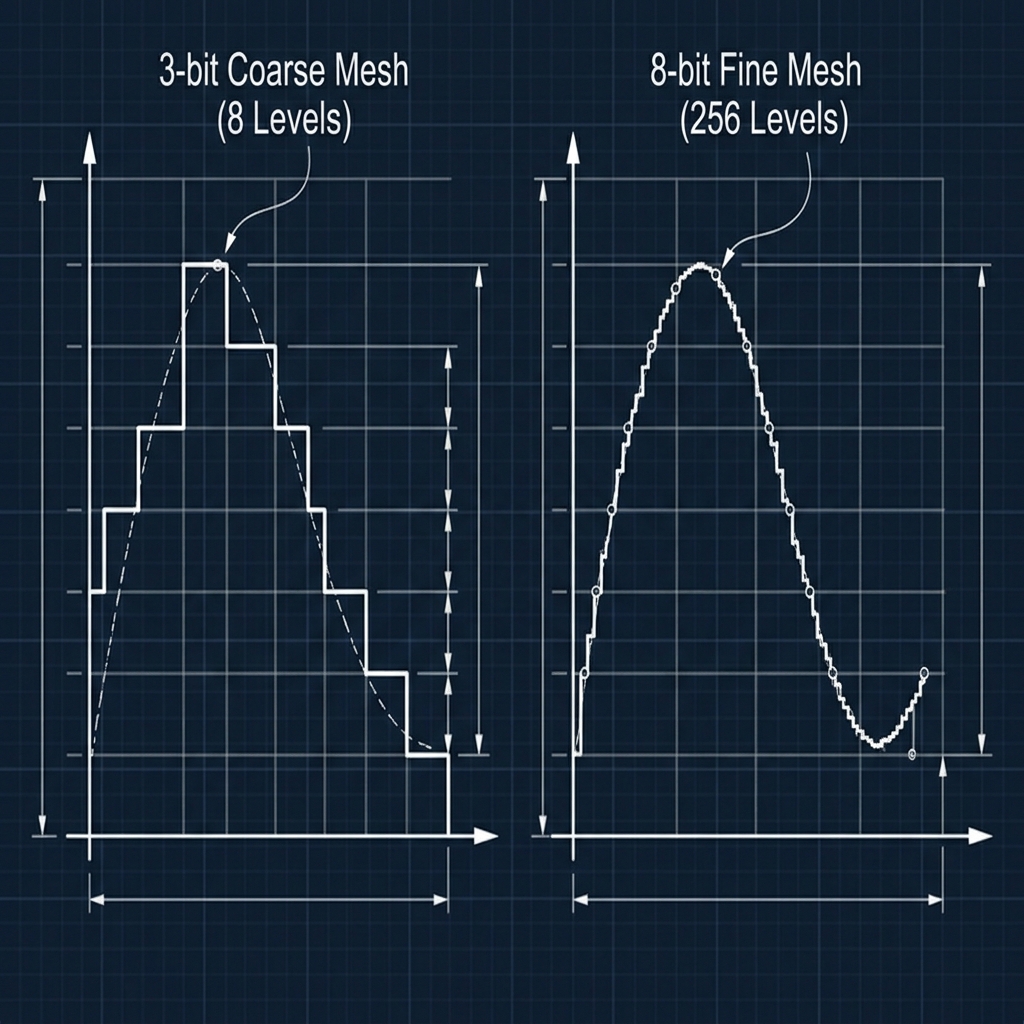
How close can our digital staircase approximate reality? That depends on the ADC's Resolution. Resolution refers to the number of binary bits the converter uses to represent the signal, which dictates the number of steps on our measurement staircase.
- A 3-bit ADC has only 23 = 8 steps. The staircase is coarse, jagged, and introduces substantial quantization noise.
- An 8-bit ADC provides 28 = 256 steps, which is sufficient for basic sensing but still relatively coarse.
- A 12-bit ADC provides 212 = 4096 steps, offering a fine mesh that captures small changes with minimal noise.
- A 16-bit ADC offers 216 = 65,536 steps, resolving microvolt fluctuations for high-fidelity audio or medical instrumentation.
By increasing resolution, we make the grid mesh finer, allowing the machine to capture a closer approximation of the physical wave.
Comparison of grid density for 3-bit vs 8-bit resolutions
6. Reference Voltage: The Calibration Ruler
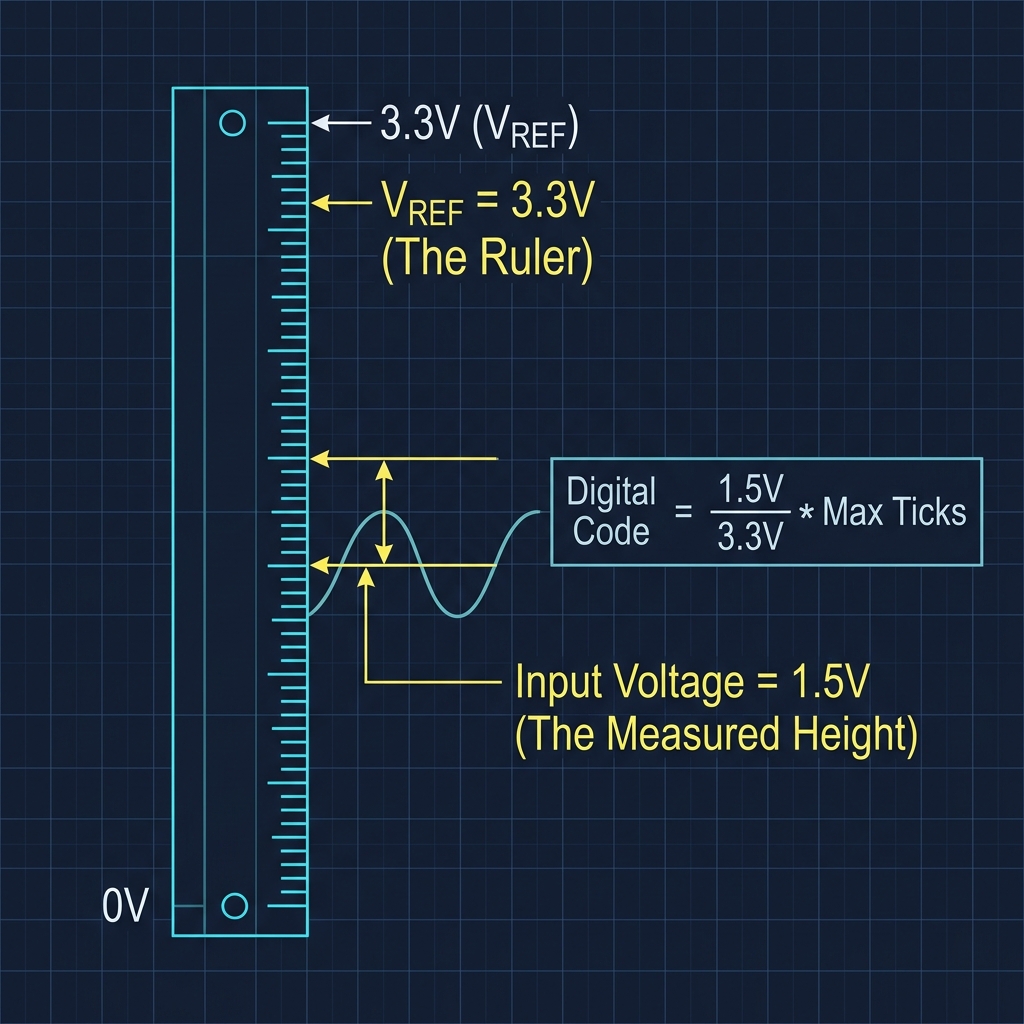
To assign digital numbers to analog voltages, the ADC needs a ruler. This ruler is the Reference Voltage (VREF). The reference voltage defines the maximum physical voltage the ADC can measure, which corresponds to the maximum digital count.
If we have a 12-bit ADC (0 to 4095) with a VREF of 3.3V:
- An input of 0.0V resolves to 0.
- An input of 3.3V resolves to 4095.
- An input of 1.65V resolves to exactly 2048.
If the reference voltage fluctuates, our measurements fluctuate too. If VREF drops to 3.0V due to poor power supply regulation, an input of 1.5V will resolve to 2048 instead of 1861, causing a measurement error. Precise calibration of VREF is the cornerstone of accurate physical observation.
Reference voltage acting as a calibrated measuring scale
7. The Conversion Pipeline: Sample, Hold, Convert, Store
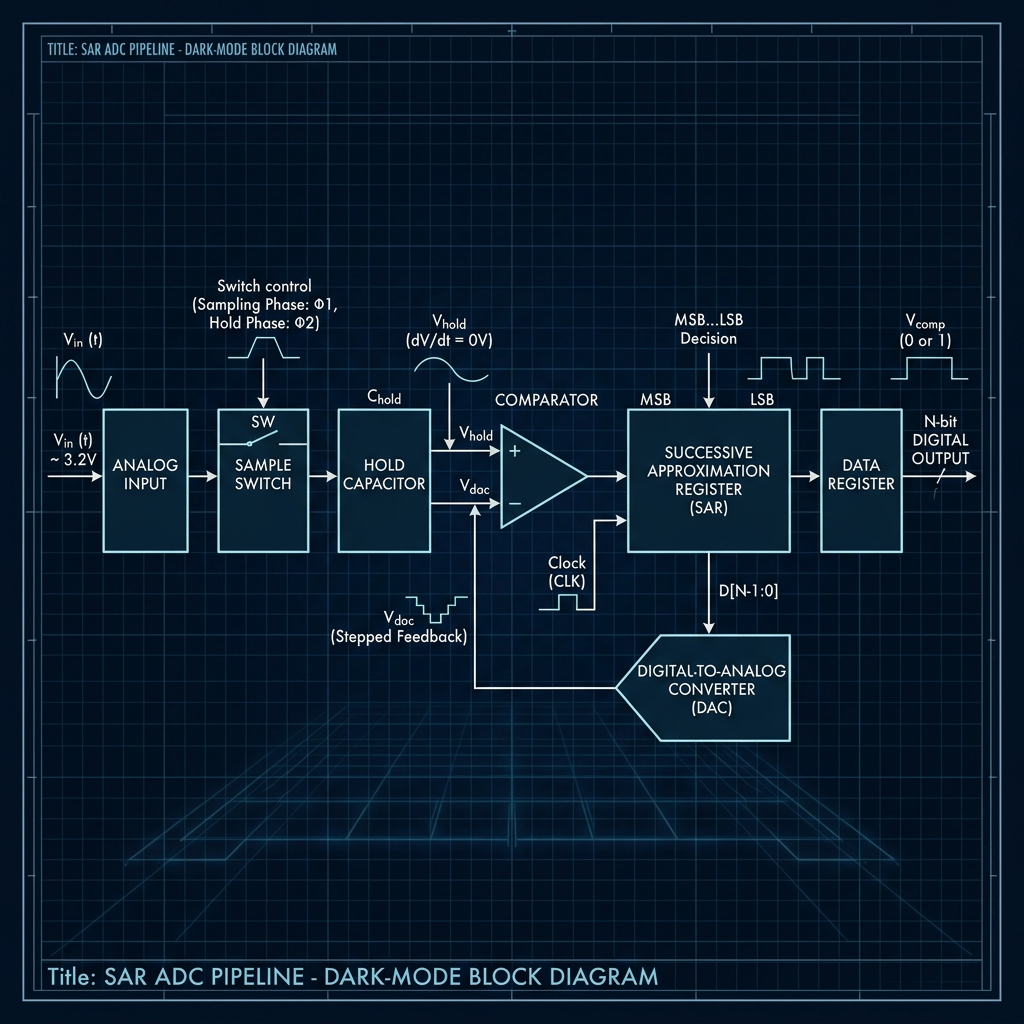
How does the physical conversion happen? Most microcontrollers use a Successive Approximation Register (SAR) ADC. The hardware processes each sample through a four-stage pipeline:
1. Sample: A physical switch closes briefly, connecting the external pin to an internal capacitor.
2. Hold: The switch opens. The capacitor 'holds' the captured charge steady so the voltage doesn't change during conversion.
3. Convert: A comparator compares the held voltage to a series of voltages generated by an internal DAC. Using a binary search (Successive Approximation), it tests the most significant bit first, deciding whether the signal is above or below half of VREF, and repeats for each bit down to the LSB.
4. Store: Once all bits are decided, the binary result is copied to a data register, raising an interrupt or DMA request so the CPU can read it.
SAR ADC hardware blocks: Sample switch, Hold capacitor, Comparator, and SAR register
8. Accuracy vs Precision
In embedded sensing, engineers often confuse two critical terms: Accuracy and Precision. They are not the same.
- Accuracy is how close a measurement is to the true physical value. An accurate system has minimal calibration offset.
- Precision is how consistent and repeatable the measurements are when the same input is read multiple times. A precise system has low noise.
A system can be highly precise but inaccurate (giving highly repeatable, low-noise readings that are calibrated incorrectly) or highly accurate but imprecise (averaging to the correct value but showing substantial noise on each individual sample). Below is a visual representation of these states:
9. Capturing Reality
Let's observe these conversion behaviors. In the interactive panel below, modify signal frequency, resolution, and sampling rate to watch how an analog signal is sliced and rounded into digital numbers.
10. The Cost of Observation
What happens when our observation parameters are configured incorrectly? In the simulator below, adjust the reference voltage, resolution, and sample rate to induce signal clipping, aliasing (undersampling), or high quantization stepping.
11. Real Embedded Applications
ADCs are the sensory organs of embedded silicon. They monitor the health of battery cells in electric vehicles, translate analog temperature sensors (like thermistors or RTDs) into precise degrees, decode phase currents for brushless DC motor control, digitize microphone voice data in smart assistants, and capture cardiac electrical potentials in medical ECG monitors. Without the ADC, a processor is deaf, blind, and isolated from physical reality.
The Sensory Handshake
Timers taught machines when to pay attention. ADCs taught machines how to translate reality into something computation could understand.
Yet observing reality is only half the story. Once a machine has observed its environment and decided on a course of action, it must eventually speak back—driving physical outputs and painting analog actions onto the physical world.
A processor without an ADC is a brain without senses—trapped in a silent chamber of its own logical abstractions.
Engineering concepts you don't just read — you experience.
Founded in 2026.
PrajnaEdge is a technology company exploring the space between understanding technology, experimenting with ideas, and turning them into things that can be experienced.
Our Mission
To make technology easier to explore, deeper to understand, and more exciting to experience.
Our Vision
To build a technology ecosystem where curiosity, experimentation and creation continuously lead to one another.
Where it began
Embedded Systems
PrajnaEdge began with Embedded Systems — exploring the foundations that connect hardware, software and intelligent computation.
The first technology universe is built around that foundation. The journey will expand as new ideas, experiments and products emerge.
I am the engineer behind the design, development, and content of PrajnaEdge. I build low-level systems where code directly controls hardware, bridging the gap between register-level silicon behavior and intelligent edge decision loops.
I am an Embedded Firmware Engineer focused on developing software for resource-constrained systems. My experience spans bare-metal firmware, device drivers, microcontroller peripherals, and communication protocols, working across the boundary between hardware and software.
My work has involved microcontroller-based systems, real-time behaviour, hardware interfaces, and communication technologies such as CAN, CAN FD, UART, SPI, and I²C. I am particularly interested in understanding systems from the lowest level upward—from registers and peripherals to intelligent edge systems.
ENGINEERING PHILOSOPHY
Engineering is not just about writing code; it is about managing constraints, timings, and physical hardware characteristics. True mastery of complex systems comes from understanding the interactions across different layers of the stack.
This conviction is why I built PrajnaEdge—to bridge the gap between conceptual theory and direct, register-level physical reality.
Where it all began — understanding the physical layer of computation. Circuits, signals, and systems gave me a mental model of how information moves through hardware.
⬡
Connects to Systems Understanding circuits directly enables writing firmware that talks to peripherals at the register level.
What it is
BTech in Electronics and Communication
Undergraduate foundation covering analog & digital circuits, signal processing, microprocessors, and communication systems.
CircuitsSignal ProcessingMicroprocessorsVLSI
What I did
Core Engineering Fundamentals
Studied semiconductor physics, digital logic design, and embedded microcontrollers. Built prototypes using 8-bit MCUs.
8051Logic DesignPCB Basics
What I learned
The Hardware Mental Model
Every software abstraction sits on physical reality. Understanding silicon teaches you why timing, power, and noise are first-class engineering problems.
Let's Connect
Interested in embedded systems, AI, or building something meaningful? I'd love to hear from you.
PrajnaEdge is an independent education platform built to make knowledge freely accessible.
If you find PrajnaEdge useful, you can support its continued development.
Your support helps fund the time, tools, infrastructure, and experimentation that go into building and maintaining PrajnaEdge.
Select Region
Select Amount
₹
Select an amount to support PrajnaEdge.
Legal & Privacy
Last updated: September 2026
1. Terms of Use
Welcome to PrajnaEdge (prajnaedge.dev), an independent engineering and technology platform created and maintained by Devaharsha Meesarapu. By using this website, you agree to these terms.
Educational & Research Focus: PrajnaEdge publishes interactive technical explorations, architectural models, and simulation walk-throughs covering embedded systems, computer architecture, operating systems, and edge artificial intelligence. All materials, interactive tools, and code demonstrations are provided solely for educational and conceptual understanding.
Hardware & Firmware Disclaimer: Embedded programming interacts directly with hardware registers, physical voltages, and precise timing. While all writeups and code demonstrations are prepared with care, they are provided "as is" without warranty of any kind. You are responsible for reviewing component datasheets, circuit schematics, and electrical ratings before deploying code to physical microcontrollers or custom hardware.
PrajnaEdge is committed to user privacy and minimal data collection. We do not sell, rent, or monetize your personal information.
Voluntary Correspondence: When you submit a message through the Contact or Feedback forms, or write directly to contact@prajnaedge.dev, we receive your name, email address, and message. This information is used strictly to reply to your inquiry.
Server Diagnostics: Standard web hosting infrastructure automatically logs basic technical access data (such as IP address, browser type, and timestamps) for server security, performance monitoring, and error diagnostics.
Local Storage: PrajnaEdge uses client-side browser localStorage purely to remember your interface preferences on your device (such as sound preferences for animations and tutorial display states). No personal identity data is stored in localStorage.
3. Advertising & Cookies
To help support platform operation and hosting, PrajnaEdge displays advertisements served by third-party advertising partners, including Google AdSense.
Advertising Cookies: Google and other third-party vendors use cookies to serve ads based on your prior visits to this website and other websites across the Internet.
DoubleClick / DART Cookie: Google's use of advertising cookies enables it and its partners to serve ads based on your visit to PrajnaEdge and other sites on the web.
Third-Party Ad Networks: When advertisements are requested by your browser, third-party ad networks automatically receive your IP address and may use technologies such as cookies or web beacons to measure ad effectiveness. PrajnaEdge does not control these cookies set by third-party advertisers.
4. Analytics
We use Google Analytics (measurement tag: G-6Y8ZVQB1V0) to evaluate anonymous, aggregate usage trends across our technical writeups.
Aggregate Telemetry: Google Analytics uses cookies to collect anonymous metrics such as page visit counts, device screen sizes, and navigation flows. This data helps us optimize responsive layouts and focus on high-interest topics.
Voluntary Support (Razorpay): If you choose to support PrajnaEdge through the Support page, transactions are handled through Razorpay's PCI-DSS compliant checkout interface. PrajnaEdge never handles, collects, or stores payment card numbers, UPI PINs, or banking credentials.
5. User Rights & Contact
Depending on your jurisdiction (including rights under GDPR, CCPA/CPRA, and applicable privacy laws), you have the right to request access to, correction of, or deletion of any personal communications you have submitted. We do not sell personal data.
For any questions regarding these terms, privacy practices, or data inquiries, contact the creator directly: