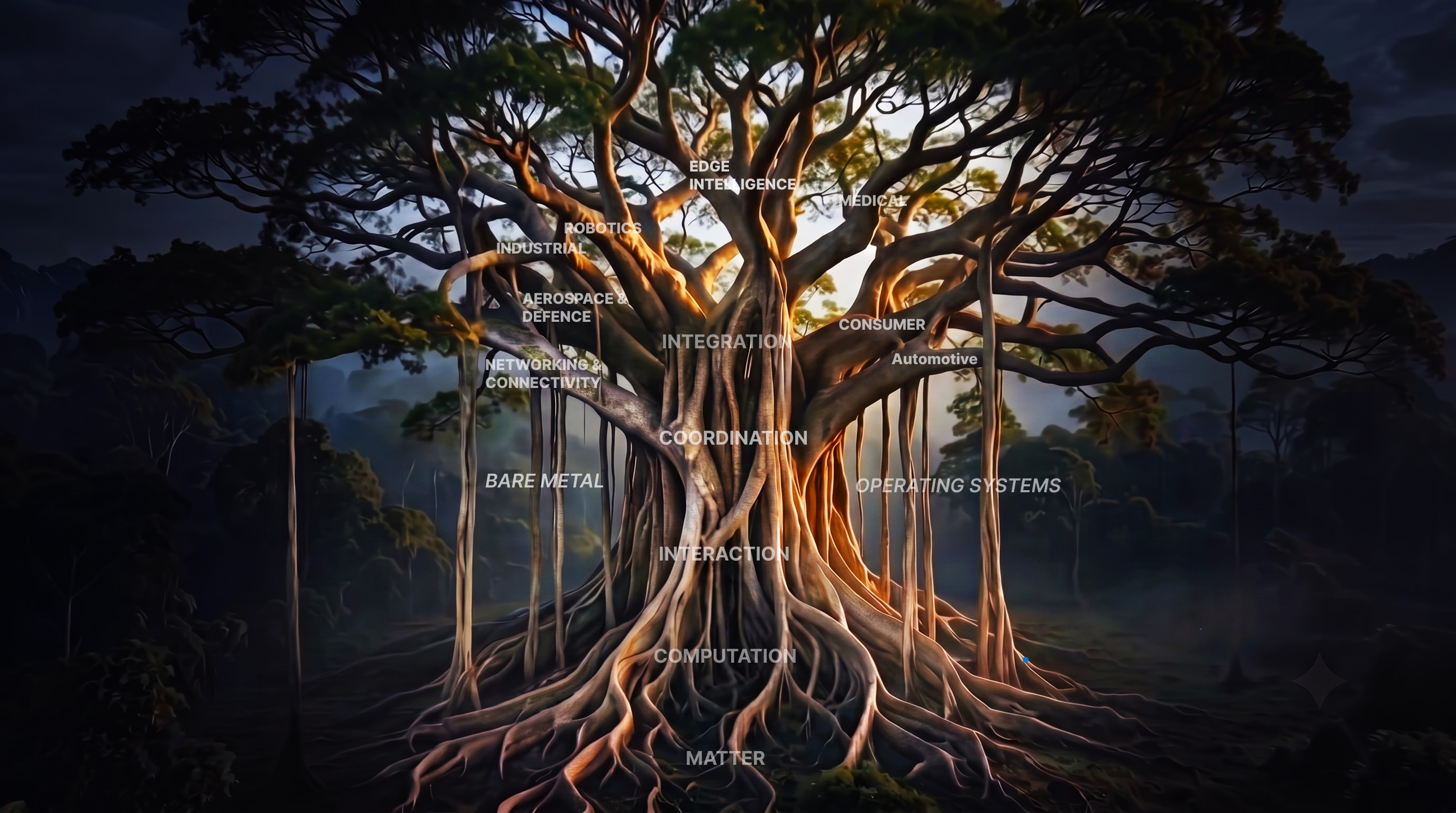
For many embedded tasks, running software directly on the metal is not just an option—it is the ideal architecture. When your application code owns the CPU, it operates with complete transparency and zero overhead.
A bare-metal system provides distinct advantages:
* Direct Control: Every register, GPIO pin, and clock configuration is modified directly by your instructions.
* Predictable Execution: There are no background threads, hidden interrupts, or scheduler tasks to steal CPU cycles. If a timer event fires, the handler runs immediately.
* Minimal Footprint: With no operating system to store, the compiled binary is tiny, leaving almost the entire Flash and RAM available for your application.
* Absolute Simplicity: Debugging is straightforward because there is only one flow of execution to trace.
If the goal is to read a temperature sensor and drive a basic display, bare metal is perfect. But as systems grow, a subtle and inevitable shift begins to occur.
2. When Simplicity Begins to Fade
Imagine a simple temperature monitoring device. In the beginning, its requirements are modest: it reads an analog sensor, processes the voltage into degrees, and updates a segment LCD. A standard bare-metal superloop handles this in a few dozen lines of code.
But successful products rarely remain simple. Over the years, new requirements are added:
* Networking: An Ethernet or Wi-Fi stack is integrated to stream readings to a cloud database.
* Storage: An SD card file system is added to log local data when network connectivity is lost.
* CAN Bus & USB: Communication interfaces are added to report diagnostics to automotive control units and technicians' laptops.
* Rich GUI: The segment LCD is replaced by a color touchscreen with animated charts.
* Safety Monitoring: A real-time watchdog task must run continuously to verify sensor sanity and trigger emergency alarms.
The hardware processor remains the same single-core chip. But instead of one simple sequential loop, you now have dozens of independent software modules, all competing for the exact same CPU cycles.
Software Evolution & CPU Resource Competition
3. The Rising Wall of Complexity
The limitations of bare metal do not appear because the hardware fails; they appear because the software scales.
When your application is composed of multiple independent modules, executing them sequentially in a single superloop introduces major design challenges:
* The Blocking Bottleneck: If the SD card write operation stalls for 100 milliseconds waiting for a flash block to erase, your CAN bus stops responding, your touch display freezes, and your safety alarms fail to trigger.
* Fragile Timing: Adjusting the processing time of one module changes the loop execution frequency of all other modules. A minor optimization in the display driver can cause the analog filtering module to sample too fast, ruining your sensor calculations.
* Manual Schedulers: To keep everything cooperative, you are forced to break tasks into manual state machines, poll hardware status flags instead of waiting, and coordinate priorities using complex nested interrupts.
Instead of writing application logic, you spend your time writing, debugging, and maintaining a custom scheduler.
4. The Birth of the Operating System
Operating Systems were not created because bare metal is bad. They were created because coordinating growing software became increasingly difficult.
When software reaches a certain size, managing the execution of code becomes as important as writing the code itself. Instead of each peripheral driver and communication stack claiming direct ownership of the processor's time, they yield to a centralized coordinator. The operating system acts as this coordinator, abstracting the physical hardware into structured, isolated software services.
5. The Services of the Conductor
To manage this complex choreography, an Operating System introduces several key responsibilities:
* Tasks (Threads): Breaking down a large monolithic program into independent, self-contained loops that run concurrently.
* Scheduler: The decision engine that determines which task gets access to the CPU at any given millisecond.
* Context Switching: The mechanism of saving the CPU register state of a running task, loading the state of another, and resuming execution seamlessly.
* Memory Management: Assigning isolated stack and heap boundaries to different tasks to prevent a crash in one task from corrupting the entire system.
* Synchronization (Mutexes & Semaphores): Providing mechanisms to protect shared resources, ensuring two tasks do not write to the same SPI port or memory buffer simultaneously.
* Inter-process Communication (IPC): Defining queues and mailboxes so tasks can exchange data and synchronize events without tight coupling.
* Device Drivers: Abstracting physical hardware registers behind standard read, write, and control APIs.
6. The Path to the Kernel
Each of these services operates as a module within a larger system. To coordinate them all, we need a single, trusted coordinator that sits at the center of the architecture.
This central coordinator is the Kernel. But who coordinates all of this? How does a single piece of software manage to multiplex the CPU, intercept interrupts, and protect memory boundaries without introducing massive latency?
The next exploration begins at the heart of this architecture.
The Conductor of the Machine
All of these coordination services — managing tasks, saving CPU states, protecting memory, and synchronizing resources — do not run in isolation.
They are bound together into a single, unified software core that manages the interface between the hardware and the application layers.
We call this core software the Kernel.
But how does a single piece of software manage to coordinate multiple independent programs on a processor that can only execute one instruction at a time? To understand the operating system, we must first answer the next question.
The kernel is the silent conductor, turning a clash of competing processes into a symphony of execution.
Engineering concepts you don't just read — you experience.
Founded in 2026.
PrajnaEdge is a technology company exploring the space between understanding technology, experimenting with ideas, and turning them into things that can be experienced.
Our Mission
To make technology easier to explore, deeper to understand, and more exciting to experience.
Our Vision
To build a technology ecosystem where curiosity, experimentation and creation continuously lead to one another.
Where it began
Embedded Systems
PrajnaEdge began with Embedded Systems — exploring the foundations that connect hardware, software and intelligent computation.
The first technology universe is built around that foundation. The journey will expand as new ideas, experiments and products emerge.
I am the engineer behind the design, development, and content of PrajnaEdge. I build low-level systems where code directly controls hardware, bridging the gap between register-level silicon behavior and intelligent edge decision loops.
I am an Embedded Firmware Engineer focused on developing software for resource-constrained systems. My experience spans bare-metal firmware, device drivers, microcontroller peripherals, and communication protocols, working across the boundary between hardware and software.
My work has involved microcontroller-based systems, real-time behaviour, hardware interfaces, and communication technologies such as CAN, CAN FD, UART, SPI, and I²C. I am particularly interested in understanding systems from the lowest level upward—from registers and peripherals to intelligent edge systems.
ENGINEERING PHILOSOPHY
Engineering is not just about writing code; it is about managing constraints, timings, and physical hardware characteristics. True mastery of complex systems comes from understanding the interactions across different layers of the stack.
This conviction is why I built PrajnaEdge—to bridge the gap between conceptual theory and direct, register-level physical reality.
Open to collaborations, research, and interesting engineering conversations.
Help Improve PrajnaEdge
Found something to improve? I'd love to hear your thoughts.
Bare Metal
Software that runs directly on hardware without an operating system.
Applications
↑
Operating Systems
YOU ARE HERE
Bare Metal
Processor
↑
Hardware
"Every embedded application begins long before main()."
Operating Systems
An Operating System manages hardware and software resources so complex applications can work efficiently.
Applications
↑
YOU ARE HERE
Operating Systems
Bare Metal
↑
Processor
↑
Hardware
"When one loop is no longer enough to carry the burden."
Support PrajnaEdge
PrajnaEdge is an independent education platform built to make knowledge freely accessible.
If you find PrajnaEdge useful, you can support its continued development.
Your support helps fund the time, tools, infrastructure, and experimentation that go into building and maintaining PrajnaEdge.
Select Region
Select Amount
₹
Select an amount to support PrajnaEdge.
Legal Information
Product Terms & Licensing
1. Terms of Use
PrajnaEdge is an interactive learning platform designed for systems engineers, developers, and technology enthusiasts. The educational materials, simulation blocks, and visual code tracers are provided for instruction and concept validation. We make no warranty regarding their completeness or applicability to real-world industrial systems.
PrajnaEdge is committed to learning privacy. We do not sell user data. Analytical event tracking is used solely to study click telemetry and help improve visual guides.