Coordination
When Machines Learned to Delegate
The moment processors stopped carrying every byte themselves.
DMADirect Memory AccessCircular BufferInterrupt StormSystem Performance
1. Interrupts Solved Waiting
In our previous exploration, we watched the CPU break free from the waste of polling. Rather than spinning in an endless while(1) loop actively asking peripherals 'Has anything happened?', the core could now sleep or execute background logic. The hardware itself took responsibility for gaining attention, alerting the CPU only when a physical button was pressed, a timer overflowed, or a byte landed in a register. The coordination loop evolved into a neat event-driven diagram:
Event → Interrupt Request (IRQ) → CPU Handles Event
This was a monumental improvement. The CPU slept when idle, power consumption dropped, and real-time responsiveness was guaranteed. But as embedded systems grew more complex and physical data rates increased, this event-driven success story revealed a new, severe bottleneck: the CPU was now spending all its energy simply responding.
2. The Growing Burden
Consider a modern microsecond-scale system. A high-speed UART port is receiving data packets at 921,600 baud, translating to roughly 92,000 bytes per second. An ADC temperature sensor is continuously sampling at 100 kHz. A CAN network is delivering vehicle safety packets at 1 Mbps.
Without a helper, the CPU must trigger an interrupt for every single UART byte, every single ADC sample, and every single CAN frame. This means the CPU stack-saves, branches, reads a register, copies the byte to RAM, branches back, and restores context—over 200,000 times every second. At a CPU frequency of 16 MHz, the instruction cycles consumed solely by this entry-and-exit overhead (typically 12 to 24 cycles each way) completely devour the processor's capacity. This state of constant preemption is called an Interrupt Storm. The CPU is no longer waiting, but it has become a victim of its own responsiveness, trapped in a loop of stack pushes and context restores.
3. The Data Mover Problem
When we look closely at what the CPU does inside these high-rate interrupt handlers, we find a glaring inefficiency. The code inside USART1_IRQHandler() is almost always a basic copy routine:
void USART1_IRQHandler(void) {
if (USART1->SR & USART_SR_RXNE) {
rx_buffer[rx_index++] = USART1->DR;
}
}
No calculations are performed. No algorithms are run. The CPU performs no logic or control decisions. It is acting as a dumb shovel, copying data from a hardware register (USART1->DR) to a memory address (rx_buffer). Utilizing an advanced, arithmetic-logic-rich processor core simply to move individual bytes is like employing a senior software architect to carry boxes of paper from the receiving bay to the printer cupboard. It is a massive waste of computational power.
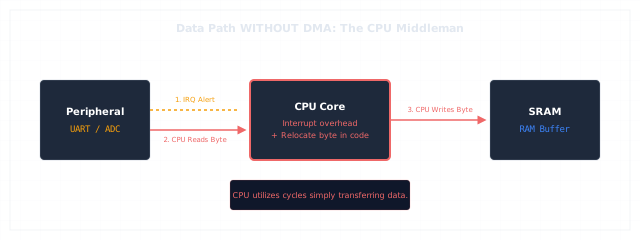
The CPU-driven data path: the processor acts as a middleman for every byte.
4. The Reversal
To break this bottleneck, we must remove the CPU from the data transit path entirely. We need a way to connect peripherals directly to system memory.
This is the purpose of Direct Memory Access (DMA). A DMA controller is a dedicated, specialized hardware coprocessor designed for a single, simple duty: moving bytes. It is a bus master, capable of taking control of the microcontroller's shared memory buses to transfer data directly from peripheral registers to SRAM arrays, completely bypassing the CPU core. The CPU is freed from the data highway, delegating the physical movement of information to dedicated silicon circuits.
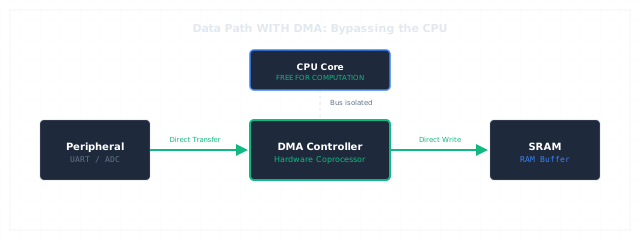
The DMA-driven data path: data bypasses the CPU completely.
5. The Anatomy of DMA
A DMA transfer cycle unfolds in four hardware stages, independent of CPU software:
1. Peripheral Request: The peripheral (e.g., UART RX buffer full) asserts a DMA request line to the DMA controller.
2. Bus Arbitration: The DMA controller requests control of the system bus. The bus matrix grants access, temporarily pausing the CPU's bus access for a single clock cycle.
3. Memory Transfer: The DMA controller reads the data from the peripheral register and writes it directly to the target RAM address in a single step. It automatically increments the target RAM pointer and decrements its internal transfer counter.
4. Completion Notification: Only when the internal counter reaches zero (signaling that an entire block of data, such as a 512-byte packet, has been completely copied) does the DMA controller assert an IRQ line to the CPU. The CPU is interrupted exactly once at the end of the block, rather than 512 times for individual bytes.
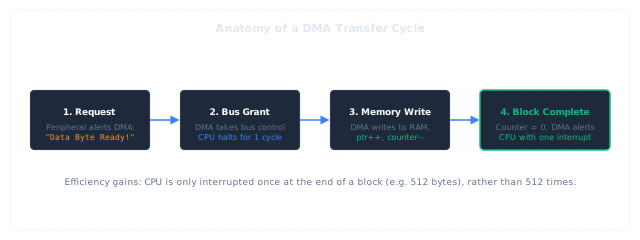
The four stages of a hardware-managed DMA transfer loop.
6. A Tale of Two Systems
The difference between these two paradigms becomes stark when comparing system load. In an interrupt-only system, CPU utilization scales linearly with data rates; double the sampling speed, and you double the CPU overhead, leading to inevitable saturation. In a DMA-enabled system, the CPU load remains flat at near-zero, regardless of sampling rates. The hardware transfers data in the background, allowing the CPU to execute real-time calculations or enter low-power sleep modes while megabytes of data stream through the system.
7. Circular Buffers and Continuous Streams
To manage continuous high-rate data streams (such as audio signals, high-frequency ADC sweeps, or serial packets) without gaps or memory exhaustion, DMA controllers utilize Circular Buffers.
A circular buffer is a contiguous block of RAM that wraps around on itself. The DMA controller is programmed with the buffer's start address and length. As it writes data, it moves its write pointer forward. When it reaches the end of the buffer, it automatically rolls back to the starting address, creating a seamless, infinite loop of data writing. The CPU read pointer follows behind it, processing data blocks. To prevent data corruption, the CPU must read faster than the DMA writes; if the DMA write pointer overlaps the CPU read pointer, a buffer overrun occurs, and old data is lost.
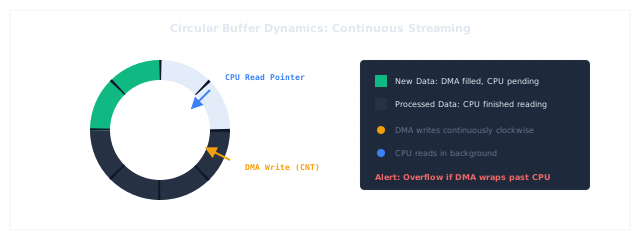
The circular buffer write and read pointer dynamics.
8. The CPU Becomes Free Again
By delegating the movement of information to the DMA controller, the processor returns to its true calling: computation. Instead of burning millions of cycles copying data registers, the CPU can now spend its capacity running digital filters, executing control algorithms, computing fast Fourier transforms, or parsing complex protocol layers. The processor is no longer a physical packer of bytes; it is once again the intelligent coordinator of the machine.
9. Real Embedded Examples
DMA is the silent backbone of modern consumer and industrial electronics. In audio systems, DMA feeds samples to the DAC codec continuously to prevent audio glitching. In smartphones, DMA streams pixel arrays from the camera sensor directly to RAM buffers. In automotive ECUs, DMA collects CAN messages in background SRAM blocks, allowing the processor to query network messages on-demand without dealing with frame-level reception interrupts.
Without DMA, high-speed interfaces like USB, Ethernet, and SD card storage would be physically impossible, as the CPU could never copy bytes fast enough to keep up with the wire speed. By learning to delegate, machines finally learned to scale.
The Architecture of Attention
Polling taught machines to wait. Interrupts taught machines to respond. DMA taught machines to delegate.
With these strategies, coordination has evolved from simple timekeeping to observation, action, attention, response, and delegation. The movement of information has ceased to be the bottleneck.
But a new question now emerges. Once a system can efficiently collect, move, and store physical information in memory...
How does it begin to understand it?
That question leads us out of coordination—and directly into intelligence.
Delegation is not a luxury for a processor; it is the prerequisite for intelligence.
Current Exploration
When Machines Learned to Delegate