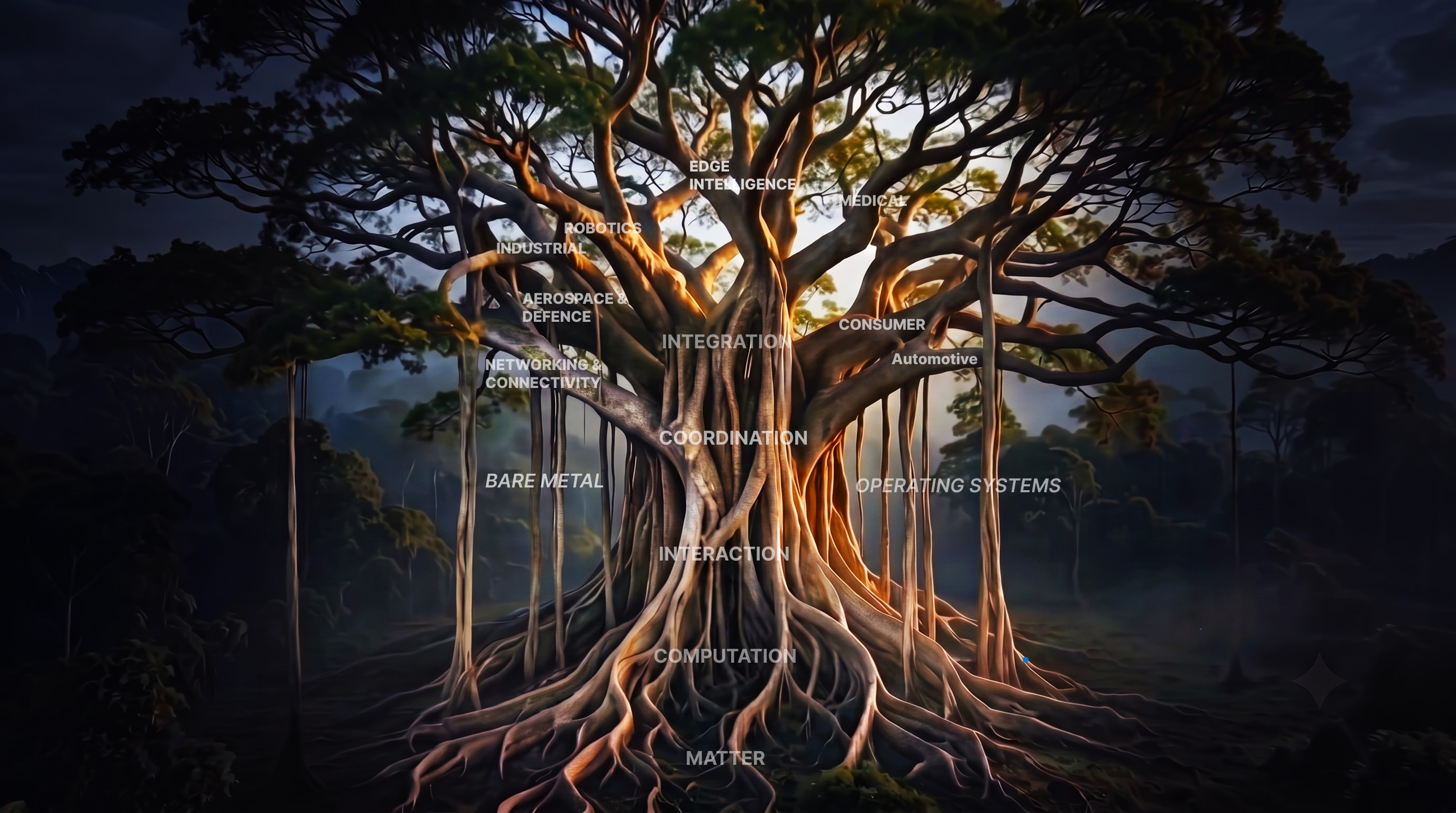
Explore the ideas, systems and connections that shape technology — choose any node to begin your journey.
Embedded Systems Tree
Sort by:
Edge AI Demonstrations
Deploying neural networks and intelligent decision loops on raw silicon targets.
Sort:
Operating Systems
When Code Comes Alive
How a program becomes something the Kernel can manage.
ProcessThreadProgramKernelCPUOperating Systems
1. The Passive Blueprint
When you compile your C or assembly code, the toolchain generates an ELF binary or raw hex file.
But what actually runs when you power on the processor? Is it the program itself, or is it something else?
* A Program is a static collection of instructions and data sitting passively on your flash memory or hard drive. It does nothing on its own.
* A Process is the active, living instance of that program loaded into memory and running under the supervision of the Kernel.
To understand how operating systems coordinate concurrent software, we must trace this transition from passive instructions to active execution paths.
2. The Execution Hierarchy
Before we dive into the scheduling algorithms, we must establish a clear hierarchy of running software:
The Execution Hierarchy
3. Active Execution: The Process
When the Kernel loads a Program into RAM, it creates a Process. A Process is not simply a copy of the code; it is a complete, isolated sandbox.
The Process owns all resources required for execution:
* Private Memory Space: Isolated regions of RAM that other processes cannot read or modify.
* Resources: File descriptors, network sockets, and hardware ports assigned to that running application.
* Execution State: Status metrics tracking credentials, privileges, and context data.
Within this Process sandbox runs the actual work. This is the role of the Thread.
A Thread is the actual path of execution inside a Process. A Process represents resource ownership; a Thread represents execution state. Every Process has at least one Thread, but advanced applications can spawn multiple Threads that share the same Process memory space.
4. Inside the Container
To understand the relationship between a Process and its Threads, we can look at how resources are shared inside the container:
Process vs. Thread Architecture
5. The Anatomical View
When the Kernel manages a Process, it maps out a strict layout within the system RAM. This structure contains both the program resources and the execution states of the threads:
* Program Code (Text): The compiled machine instructions read directly from flash or disk. This region is read-only to prevent programs from modifying themselves.
* Stack: A fast, private memory region allocated to each thread. It tracks active function calls, parameters, local variables, and return targets.
* Heap: A large dynamic memory pool used by the application during runtime. Memory is requested via malloc or new and must be freed explicitly.
* Registers: High-speed hardware CPU storage slots. When a thread is executing, it writes directly to registers. When it yields, its register state must be saved.
* Program Counter (PC): The specialized CPU register that holds the memory address of the next machine instruction to be executed by the active thread.
* Process State: Flags and identifiers monitored by the Kernel that track process privileges, identity numbers, and current execution eligibility.
6. The Unit of Orchestration
In the previous exploration, we saw that the Kernel coordinates system resources. Now we can see the exact target of that coordination.
The Kernel does not interact with static files or programs directly. It schedules the active execution threads running within a Process sandbox. The Process acts as the boundary of resource ownership:
* A crash inside one Process is isolated. Because Process RAM blocks are separated, one application cannot accidentally overwrite or crash another.
* Before the Kernel can schedule clock cycles or allocate RAM space, it first needs a Process structure.
The Process is the fundamental container of running code that makes multiplexed operating systems possible.
7. The Lifecycle
The Kernel maintains a complete tracking directory of all active processes. But a process does not remain in the same execution state forever.
As it runs instructions, waits for network packets, yields to high-priority tasks, or shuts down, its execution eligibility changes. The Kernel must continuously monitor and adjust these states to maintain high performance.
The journey of execution is mapped through these changing stages.
The Lifecycle of Execution
A process is not a static container. It is a dynamic, living entity.
As it executes instructions, handles hardware inputs, and waits for memory resources, its relationship with the CPU changes.
The Kernel must continuously track this changing behavior to decide who runs next.
The journey of execution is mapped through these changing states.
A program is a map, a process is the journey, and the thread is the step.
Engineering concepts you don't just read — you experience.
Founded in 2026.
PrajnaEdge is a technology company exploring the space between understanding technology, experimenting with ideas, and turning them into things that can be experienced.
Our Mission
To make technology easier to explore, deeper to understand, and more exciting to experience.
Our Vision
To build a technology ecosystem where curiosity, experimentation and creation continuously lead to one another.
Where it began
Embedded Systems
PrajnaEdge began with Embedded Systems — exploring the foundations that connect hardware, software and intelligent computation.
The first technology universe is built around that foundation. The journey will expand as new ideas, experiments and products emerge.
I am the engineer behind the design, development, and content of PrajnaEdge. I build low-level systems where code directly controls hardware, bridging the gap between register-level silicon behavior and intelligent edge decision loops.
I am an Embedded Firmware Engineer focused on developing software for resource-constrained systems. My experience spans bare-metal firmware, device drivers, microcontroller peripherals, and communication protocols, working across the boundary between hardware and software.
My work has involved microcontroller-based systems, real-time behaviour, hardware interfaces, and communication technologies such as CAN, CAN FD, UART, SPI, and I²C. I am particularly interested in understanding systems from the lowest level upward—from registers and peripherals to intelligent edge systems.
ENGINEERING PHILOSOPHY
Engineering is not just about writing code; it is about managing constraints, timings, and physical hardware characteristics. True mastery of complex systems comes from understanding the interactions across different layers of the stack.
This conviction is why I built PrajnaEdge—to bridge the gap between conceptual theory and direct, register-level physical reality.
Open to collaborations, research, and interesting engineering conversations.
Help Improve PrajnaEdge
Found something to improve? I'd love to hear your thoughts.
Bare Metal
Software that runs directly on hardware without an operating system.
Applications
↑
Operating Systems
YOU ARE HERE
Bare Metal
Processor
↑
Hardware
"Every embedded application begins long before main()."
Operating Systems
An Operating System manages hardware and software resources so complex applications can work efficiently.
Applications
↑
YOU ARE HERE
Operating Systems
Bare Metal
↑
Processor
↑
Hardware
"When one loop is no longer enough to carry the burden."
Support PrajnaEdge
PrajnaEdge is an independent education platform built to make knowledge freely accessible.
If you find PrajnaEdge useful, you can support its continued development.
Your support helps fund the time, tools, infrastructure, and experimentation that go into building and maintaining PrajnaEdge.
Select Region
Select Amount
₹
Select an amount to support PrajnaEdge.
Legal Information
Product Terms & Licensing
1. Terms of Use
PrajnaEdge is an interactive learning platform designed for systems engineers, developers, and technology enthusiasts. The educational materials, simulation blocks, and visual code tracers are provided for instruction and concept validation. We make no warranty regarding their completeness or applicability to real-world industrial systems.
PrajnaEdge is committed to learning privacy. We do not sell user data. Analytical event tracking is used solely to study click telemetry and help improve visual guides.