PrajnaEdge
A curiosphere for curious minds who want to understand, experiment with, and experience technology.
To continue exploring
Technology, made tangible.

Where does intelligence run?

Explore AI that moves inference closer to the data — from the edge to the device itself.

AI inference runs at or near the point where data is generated, rather than relying on a remote cloud.
Edge AI Computer Vision

Image Classification

Can this image classifier maintain its intelligence while becoming small enough for the edge?

// Coming soon
Edge AI Playground

Image Classification

Can this image classifier maintain its intelligence while becoming small enough for the edge?

Choose an image

Upload an image
Supports JPG, JPEG, PNG
This classifier recognizes only Apple, Banana, and Orange. Other objects may be incorrectly classified as one of these classes.

Choose the model

Model size
4.91 MiB
Largest activation
~625 KiB
Test accuracy
99.11%
Measured model accuracy
Your image is processed locally in your browser.
On-Device AI
On-Device AI Playground
// Coming soon

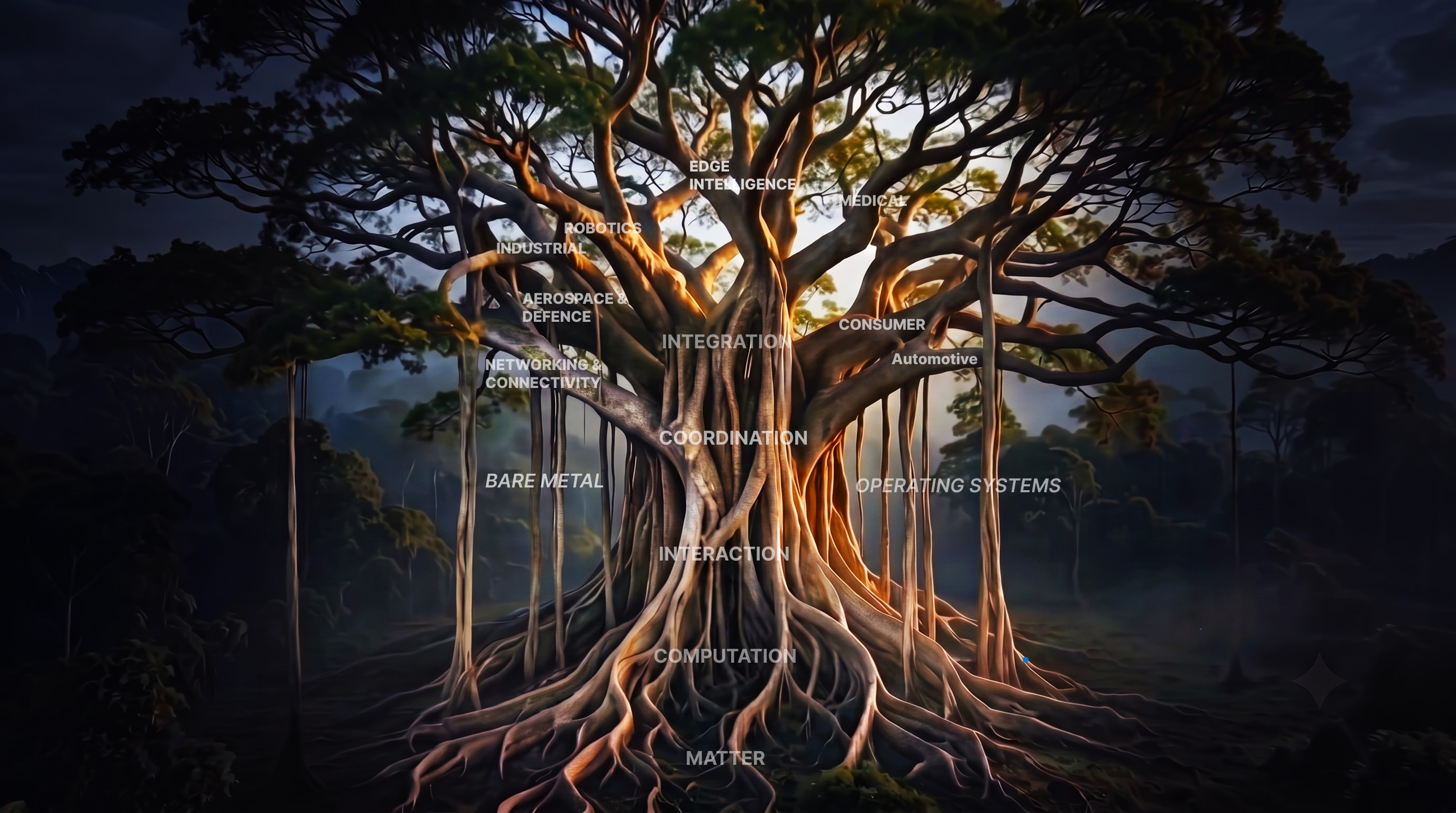
Explore the ideas, systems and connections that shape technology — choose any node to begin your journey.

PrajnaEdge Navigation Tree
Embedded Systems Tree

Edge AI Demonstrations

Deploying neural networks and intelligent decision loops on raw silicon targets.

Sort:
Operating Systems

One Brain Wasn't Enough

How computing learned to think in parallel.

Operating SystemsMulticoreConcurrenceParallelismShared Resources

1. The Single-Core Assumption

Historically, a CPU was a singular brain. To run multiple programs at the same time, the operating system had to perform a delicate illusion of multitasking. It sliced CPU execution time into tiny fragments, switching rapidly between processes so that human eyes perceived simultaneous behavior.

Our Previous Assumption: The Single-Core Timeline
Ready Queue
P3 READY
P2 READY
Active CPU Core
P1 RUNNING
Executing...

For decades, the goal of systems engineering was to make this single brain run faster.

2. The Physical Ceiling

We scaled computing power by increasing the clock frequency (gigahertz) of single processors. But around the mid-2000s, this approach hit a physical ceiling:

* The Thermal Wall: Higher speeds generate exponentially more heat. A single silicon chip running at 10 GHz would consume as much energy and generate as much heat as a small cooking surface, melting its own silicon structure. * The Voltage Boundary: We could no longer decrease transistor operating voltage without causing electric leakage (quantum tunneling) across microscopic gates.

To continue making computers faster, engineers could no longer make the single brain run quicker. Instead, they had to pack multiple distinct processor cores onto a single silicon chip.

3. Parallel Minds

The transition to multicore architectures changed the rules of software execution. In a multicore system, true physical parallelism replaces the time-shared illusion of multitasking.

Single Core
SEQUENTIAL TIME-SHARING
Core State
CORE 0: P1 [RUNNING]
Ready Queue
P2 [READY]
P3 [READY]
One active Process at a time. The operating system must perform context switches to rotate core execution.
Multi-Core
SIMULTANEOUS PROCESSING
Core States
CORE 0
P1 [RUNNING]
CORE 1
P2 [RUNNING]
Ready Queue
P3 [READY]
P4 [READY]
Multiple Processes executing simultaneously. Parallel cores execute instruction streams independently.

4. The Shared Frontier

In a single-core environment, processes execute one by one, isolated by the operating system.

But in a multicore system where processes run side-by-side, we face a new engineering bottleneck: collaborative processing. Processes often need to work together on parts of the same application.

Imagine two parallel cores processing a single task: Core 0 computes a sensor state value, and Core 1 must read that state value to control an actuator.

The Collaborative Dilemma: Shared Resources
CORE 0 (P1)
Writes: X = 42
CORE 1 (P2)
Reads: X
Shared RAM
[ X ]
Because Core 0 and Core 1 execute independently, how can P2 safely read X only after P1 has finished writing it, without accessing corrupted or stale memory?

5. Reflection

We have broken the single-processor assumption. Processes now run side-by-side across parallel cores.

But this independence breeds a new coordination puzzle.

How do Processes running at the same time exchange information?

System Tree Node Operating Systems

PrajnaEdge

Engineering concepts you don't just read — you experience.
Founded in 2026.

PrajnaEdge is a technology company exploring the space between understanding technology, experimenting with ideas, and turning them into things that can be experienced.

Our Mission

To make technology easier to explore, deeper to understand, and more exciting to experience.

Our Vision

To build a technology ecosystem where curiosity, experimentation and creation continuously lead to one another.

Where it began

Embedded Systems

PrajnaEdge began with Embedded Systems — exploring the foundations that connect hardware, software and intelligent computation.

The first technology universe is built around that foundation. The journey will expand as new ideas, experiments and products emerge.

PrajnaEdge is a technology company created by Devaharsha Meesarapu.

CREATOR PROFILE

Devaharsha Meesarapu

Embedded Systems • Firmware • Edge AI

I am the engineer behind the design, development, and content of PrajnaEdge. I build low-level systems where code directly controls hardware, bridging the gap between register-level silicon behavior and intelligent edge decision loops.

View Resume →

ABOUT ME

I am an Embedded Firmware Engineer focused on developing software for resource-constrained systems. My experience spans bare-metal firmware, device drivers, microcontroller peripherals, and communication protocols, working across the boundary between hardware and software.

My work has involved microcontroller-based systems, real-time behaviour, hardware interfaces, and communication technologies such as CAN, CAN FD, UART, SPI, and I²C. I am particularly interested in understanding systems from the lowest level upward—from registers and peripherals to intelligent edge systems.

ENGINEERING PHILOSOPHY

Engineering is not just about writing code; it is about managing constraints, timings, and physical hardware characteristics. True mastery of complex systems comes from understanding the interactions across different layers of the stack.

This conviction is why I built PrajnaEdge—to bridge the gap between conceptual theory and direct, register-level physical reality.

CONNECT

LinkedIn → GitHub →

Interactive Career Journey

Let's Connect
Interested in embedded systems, AI, or building something meaningful? I'd love to hear from you.
Open to collaborations, research, and interesting engineering conversations.
Help Improve PrajnaEdge
Found something to improve? I'd love to hear your thoughts.

Bare Metal

Software that runs directly on hardware without an operating system.

Applications
Operating Systems
YOU ARE HERE
Bare Metal
Processor
Hardware

"Every embedded application begins long before main()."

Operating Systems

An Operating System manages hardware and software resources so complex applications can work efficiently.

Applications
YOU ARE HERE
Operating Systems
Bare Metal
Processor
Hardware

"When one loop is no longer enough to carry the burden."

Support PrajnaEdge

PrajnaEdge is an independent education platform built to make knowledge freely accessible.

If you find PrajnaEdge useful, you can support its continued development.

Your support helps fund the time, tools, infrastructure, and experimentation that go into building and maintaining PrajnaEdge.

Select Region
Select Amount
Select an amount to support PrajnaEdge.