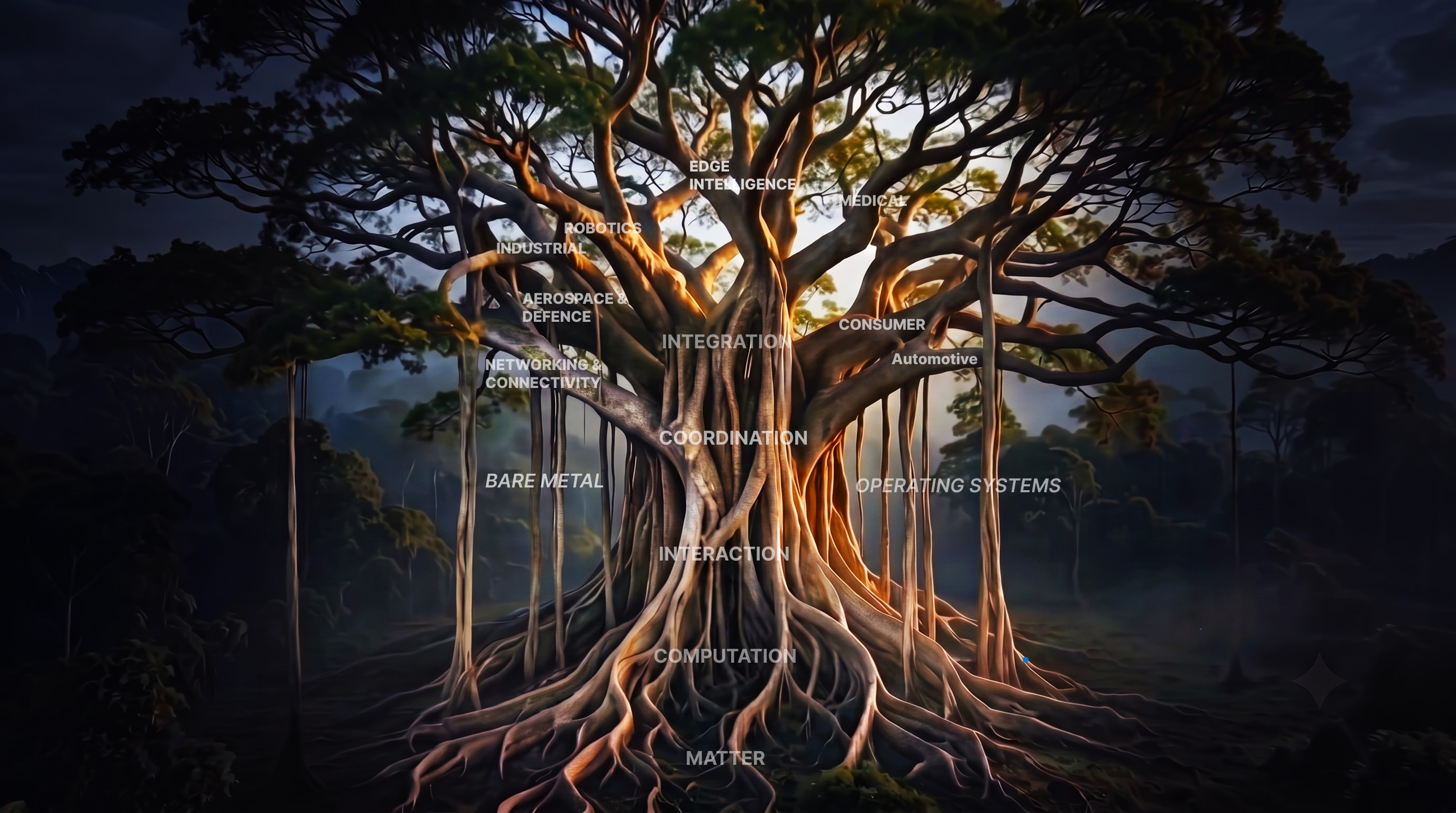
Explore the ideas, systems and connections that shape technology — choose any node to begin your journey.
Embedded Systems Tree
Sort by:
Edge AI Demonstrations
Deploying neural networks and intelligent decision loops on raw silicon targets.
Sort:
Operating Systems
Not Every OS Has the Same Job
Comparing Operating System types, environmental constraints, priority profiles, and real-time deadlines.
Operating SystemsTypes of OSWorkloadsPrioritiesRTOS
1. One OS, Different Priorities
Every operating system manages processes, memory, files, storage devices, and permissions. But how it manages them depends entirely on its goals:
The design of an operating system reflects its environment and constraints:
* Desktops & Laptops: Prioritize UI responsiveness, multitasking fairness, and user experience.
* Servers: Prioritize concurrency, throughput, reliability, and security isolation under massive network loads.
* Embedded Hardware: Prioritize minimal memory footprints, battery life, and direct hardware register access.
* Real-Time Systems: Prioritize strict, deterministic execution timing rather than raw speed.
2. Classification Profiles
Operating system classifications are not rigid, mutually exclusive categories. A single OS can fall under multiple definitions depending on its configuration and environment:
Android
→ Mobile OS
→ Embedded-style resource constraints (memory management, power optimization)
→ General-purpose kernel lineage (Linux)
Automotive Safety Controllers
→ Dedicated Embedded OS
→ Strict Real-Time constraints
Enterprise Web Servers
→ General-purpose OS technology (Linux)
→ Configured and optimized for high-concurrency server workloads
"Type" refers to a design environment and its priorities rather than a completely different kernel layout.
3. Batch Operating Systems
Historically, early computers had no interactive interfaces. Users submitted stacks of punch cards (jobs) that were processed in sequence:
Batch operating systems prioritize overall system throughput and resource utilization. There is no interactive terminal loop; once a job starts, it runs to completion or failure without user intervention.
4. General-Purpose / Time-Sharing Operating Systems
With the arrival of video terminals and interactive shells, the OS changed to share CPU execution time among multiple users:
User Space (Terminal Sessions)
↓
Shell / Applications
↓
General-Purpose OS (Time-sharing scheduler)
↓
Shared CPU / Memory Hardware
A general-purpose OS prioritizes:
* Interactive Latency: Keeping desktop windows and shell interactions responsive.
* Fairness: Preventing any single application from starving other processes.
* Compatibility: Supporting a broad spectrum of hardware configurations, file structures, and software applications.
5. Server Operating Systems
While desktop variants prioritize user interface responsiveness, server operating systems optimize for background execution:
Server operating systems prioritize:
* Concurrency: Managing thousands of active connections simultaneously without thrashing.
* Throughput: Maximizing bulk data transfers over network sockets and storage systems.
* Availability: Supporting kernel updates, storage array swaps, and configuration changes without requiring reboots.
6. Distributed Environments
In distributed setups, tasks run across multiple computing nodes:
A distributed environment coordinates multiple discrete nodes to make them behave like a single coherent system. Rather than run a single monolithic OS across all nodes, modern systems typically run standard general-purpose kernels on each machine, linking them together via networking protocols and distributed system frameworks.
7. Embedded Operating Systems
Embedded hardware operates under physical and resource constraints:
Embedded systems run a dedicated firmware image tailored to a specific product.
Their operating system profiles prioritize:
* Footprint: Stripping out memory-heavy features (like virtual memory, process isolation, or graphical desktop subsystems) to fit inside tiny RAM footprints (kilobytes to megabytes).
* Hardware Interconnection: Interfacing directly with hardware buses (SPI, I2C, CAN, GPIO, ADC, and timers) and coordinating them via custom device driver APIs.
* Low Power: Shutting down unused blocks and transitioning the CPU into deep sleep states to extend battery life.
8. Mobile Operating Systems
A mobile OS bridges general-purpose usability with embedded hardware constraints:
Phone Device
│
┌────────────┼────────────┐
↓ ↓ ↓
CPU/GPU Sensors/GPS Cellular/Radio
│ │ │
└────────────┼────────────┘
↓
Mobile OS (Optimized power/security)
Mobile operating systems prioritize:
* Power Management: Actively freezing background processes to minimize battery drain.
* Security & Isolation: Sandboxing apps to prevent unauthorized data access across the platform.
* Responsive UI: Prioritizing rendering loops and touch events to keep interactions smooth.
9. Real-Time Operating Systems (RTOS)
For many computing workloads, performance is about average responsiveness or bulk throughput. But in safety-critical systems, speed is not the primary metric:
In a real-time system, being fast is not enough. You must be predictable:
* Deterministic Timing: The system must guarantee that a critical task completes its run within a strict, bounded time window.
* Deadlines: The correctness of a real-time computation depends not only on the logical correctness of the algorithm but also on the time at which the result is produced.
A system call in a general-purpose OS completes as quickly as practical on average, but offers no absolute mathematical timing guarantees. A real-time OS (RTOS) guarantees that critical operations always execute within their assigned deadlines.
10. Priority Synthesis
The matrix below illustrates how operating system classes prioritize their core resource management responsibilities:
11. Connecting the Core Concepts
An operating system's environment shapes how it handles its core scheduling, memory, and device interface designs:
Different priority profiles alter the internal behavior of these subsystems:
* Scheduling: Desktop schedulers use multilevel queues to favor interactive GUI responsiveness, server schedulers allocate larger slices to optimize background worker threads, and real-time schedulers prioritize deterministic task deadlines.
* Memory Management: General-purpose kernels manage translation pages and disk swap spaces, while resource-limited embedded operating systems often bypass page tables and heap memory allocations to ensure efficiency.
* I/O & Protection: Mobile and desktop platforms enforce strict user/kernel separation barriers, whereas bare-metal embedded layouts frequently trade process isolation to gain direct registers control.
We have seen that operating systems can be designed around very different priorities — throughput, responsiveness, resource constraints, power, scalability, or timing.
But what happens when missing a deadline is not an acceptable form of slowness?
Engineering concepts you don't just read — you experience.
Founded in 2026.
PrajnaEdge is a technology company exploring the space between understanding technology, experimenting with ideas, and turning them into things that can be experienced.
Our Mission
To make technology easier to explore, deeper to understand, and more exciting to experience.
Our Vision
To build a technology ecosystem where curiosity, experimentation and creation continuously lead to one another.
Where it began
Embedded Systems
PrajnaEdge began with Embedded Systems — exploring the foundations that connect hardware, software and intelligent computation.
The first technology universe is built around that foundation. The journey will expand as new ideas, experiments and products emerge.
I am the engineer behind the design, development, and content of PrajnaEdge. I build low-level systems where code directly controls hardware, bridging the gap between register-level silicon behavior and intelligent edge decision loops.
I am an Embedded Firmware Engineer focused on developing software for resource-constrained systems. My experience spans bare-metal firmware, device drivers, microcontroller peripherals, and communication protocols, working across the boundary between hardware and software.
My work has involved microcontroller-based systems, real-time behaviour, hardware interfaces, and communication technologies such as CAN, CAN FD, UART, SPI, and I²C. I am particularly interested in understanding systems from the lowest level upward—from registers and peripherals to intelligent edge systems.
ENGINEERING PHILOSOPHY
Engineering is not just about writing code; it is about managing constraints, timings, and physical hardware characteristics. True mastery of complex systems comes from understanding the interactions across different layers of the stack.
This conviction is why I built PrajnaEdge—to bridge the gap between conceptual theory and direct, register-level physical reality.
Open to collaborations, research, and interesting engineering conversations.
Help Improve PrajnaEdge
Found something to improve? I'd love to hear your thoughts.
Bare Metal
Software that runs directly on hardware without an operating system.
Applications
↑
Operating Systems
YOU ARE HERE
Bare Metal
Processor
↑
Hardware
"Every embedded application begins long before main()."
Operating Systems
An Operating System manages hardware and software resources so complex applications can work efficiently.
Applications
↑
YOU ARE HERE
Operating Systems
Bare Metal
↑
Processor
↑
Hardware
"When one loop is no longer enough to carry the burden."
Support PrajnaEdge
PrajnaEdge is an independent education platform built to make knowledge freely accessible.
If you find PrajnaEdge useful, you can support its continued development.
Your support helps fund the time, tools, infrastructure, and experimentation that go into building and maintaining PrajnaEdge.
Select Region
Select Amount
₹
Select an amount to support PrajnaEdge.
Legal Information
Product Terms & Licensing
1. Terms of Use
PrajnaEdge is an interactive learning platform designed for systems engineers, developers, and technology enthusiasts. The educational materials, simulation blocks, and visual code tracers are provided for instruction and concept validation. We make no warranty regarding their completeness or applicability to real-world industrial systems.
PrajnaEdge is committed to learning privacy. We do not sell user data. Analytical event tracking is used solely to study click telemetry and help improve visual guides.