Controller
Microcontroller — The Computer Inside the Machine
How computation, memory, and hardware interfaces came together inside a single chip to control the physical world.
ControllerMicrocontrollerEmbedded SystemsSensorsActuatorsHardware
1. A machine needs a mind
A motor can spin.
A sensor can sense.
An LED can respond.
But none of them knows what to do.
A machine needs something that can sense, decide, and act.
Where does that intelligence live?
2. The computer inside
That small computer is the microcontroller.
A microcontroller is a compact computing system designed to control and interact with the world around it.
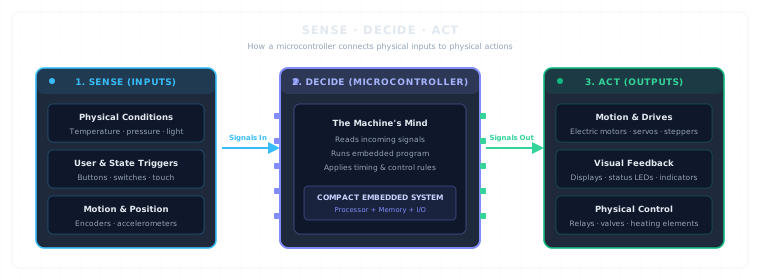
Sense, Decide, Act: How a microcontroller connects physical inputs to physical actions
It sits directly between physical inputs and physical outputs — continually reading signals, evaluating conditions, and coordinating action.
Its counterpart in general-purpose computing is the microprocessor.
3. More than a processor
A microcontroller contains a processor core — but the processor is only part of the story.
Around the core lives an entire ecosystem of integrated hardware:
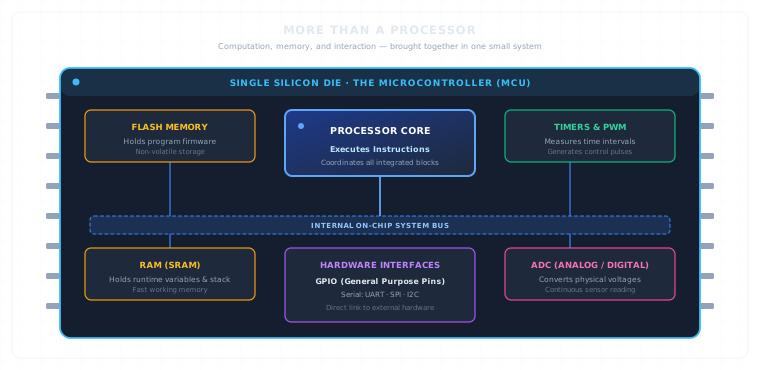
Integrated Architecture of a Microcontroller: Processor Core, Flash, RAM, Timers, ADC, and Hardware Interfaces on a single silicon die
* CPU Core: The execution engine that runs instructions.
* Flash Memory: Holds the program firmware permanently, even when power is disconnected.
* RAM: Provides fast working memory for runtime variables and operational state.
* GPIO: General-purpose pins that read digital signals and drive external circuits.
* Timers: Measure precise time intervals and generate high-speed control pulses.
* ADC: Converts continuous physical voltages from sensors into digital numbers.
* Communication Interfaces: Serial channels to exchange data with other devices.
Computation, memory, and interaction — brought together in one small system.
4. Why put everything together?
Instead of building a computer around a separate processor, separate memory modules, and external interface chips, much of what a machine needs lives inside one chip.
This single-chip integration changes everything:
* Compact: Fits into tiny enclosures, hand tools, and dense mechanical assemblies.
* Low Power: Operates efficiently on batteries and enters deep sleep states when idle.
* Predictable: Direct on-chip bus connections ensure fast, deterministic hardware responses.
* Dedicated Control: Sits quietly inside the machine, focused entirely on its assigned task.
Rather than running desktop applications, it is engineered for direct interaction with hardware.
5. A computer built for the world
The microcontroller is not trying to be a general-purpose computer.
It is built to become part of a machine.
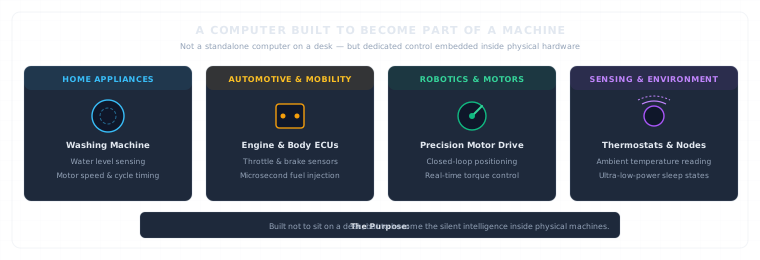
Microcontrollers embedded across real-world machines: appliances, automotive ECUs, robotics, and sensors
From the washing machine regulating its water valves and drum rotation, to the automotive ECU timing fuel injection to the microsecond, to smart thermostats and precision motor drives — the same stored-program intelligence is embedded silently into the machine itself.
A processor can compute.
A microcontroller turns that computation into control.
But how are all these pieces organized inside such a small chip?
Let's look at the architecture that makes it possible.
Current Exploration
Microcontroller — The Computer Inside the Machine